
As Amazon Associates, we earn from qualifying purchases. This means we may receive a small commission at no extra cost to you if you click through and make a purchase.
As an Amazon Associate we earn from qualifying purchases. Links on this page are affiliate links.
When comparing victron energy vs renogy solar charge controller options, you will find two robust 100A MPPT units. Both handle 12V to 48V systems and accept up to 150V PV input. The main difference lies in their physical design and connectivity approach. Victron offers a compact, lighter unit with integrated Bluetooth. Renogy provides a larger, heavier unit with extensive data logging and parallel scaling capabilities. You must choose based on space and monitoring needs.
Weight
11.1 pounds
22 pounds
Dimensions
13 x 6.3 x 11.4 inches
17.4 x 4.35 x 12 inches
Bluetooth Module
Integrated
Sold separately (BT-2)
Data Storage
30-day history
300 days operational data
Parallel Scaling
Synchronized charging
RS485 parallel ports
Color
Blue
Black
Choose the first if
- You need a lighter unit for mobile applications like RVs or boats.
- You want Bluetooth connectivity built directly into the device.
- You prefer a more compact footprint for tight installation spaces.
Choose the second if
- You require long-term data logging for system analysis.
- You are building a large system needing RS485 parallel scaling.
- You need an external temperature sensor for extreme climates.
Verdict
Choose the Victron Energy model if weight and integrated connectivity are your top priorities. Select the Renogy Rover if you need extensive data history and modular scaling for larger off-grid setups. Both units deliver reliable 100A MPPT performance for your battery bank.
Victron vs Renogy Spec Showdown
Physical Build
Edge: Victron SmartSolar MPPT 100A 150V
Victron Energy delivers a compact unit measuring 13 by 11.4 by 6.3 inches, weighing 11.1 pounds. Its blue casing is designed for space-efficient installations. Renogy provides a significantly larger and heavier device. The Renogy Rover measures 17.4 by 12 by 4.35 inches and weighs 22 pounds. Its black housing is built for rugged environments, featuring IP32 waterproofing and TVS lightning protection. You will need more mounting space for the Renogy unit. Victron is the better choice if you have limited physical room in your RV or marine setup.
Battery Compatibility
Edge: Renogy Rover 100A MPPT Solar Charge Controller
Both controllers support 12V, 24V, 36V, and 48V battery systems. Victron Energy uses intelligent charge algorithms to optimize battery longevity for standard lead-acid types. Renogy offers more granular support for specific chemistries. It includes adaptive four-stage charging for lead-acid and two-stage charging specifically for lithium and LiFePO4 batteries. Renogy explicitly lists compatibility with AGM, gel, sealed, flooded, and lithium types. If you are running a lithium battery bank, Renogy provides dedicated charging stages that may better preserve those specific cells.
Connectivity
Edge: Victron SmartSolar MPPT 100A 150V
Victron Energy includes built-in Bluetooth connectivity as a standard feature. You can use the VictronConnect app for real-time data, 30-day performance history, and firmware updates without buying extra parts. Renogy also supports Bluetooth monitoring via the Renogy DC Home app. However, the data notes that the BT-2 Bluetooth module is sold separately. You must purchase this accessory to enable wireless communication with the Renogy unit. Victron offers a more complete out-of-the-box digital experience with its integrated wireless hardware.
System Scaling
Edge: Tie
Victron Energy allows multiple SmartSolar MPPT controllers to synchronize. They behave as one unit, switching through charge stages simultaneously to optimize system-wide energy. This feature helps maintain battery longevity across a large array. Renogy supports scalability through 485 parallel ports for multi-controller setups. It also offers RS485/RS232 communication options for expansion. Renogy stores five years of data and supports external sensors for temperature compensation in extreme climates. Both brands allow you to build larger systems, but they use different communication protocols to achieve this.
Environmental Protection
Edge: Renogy Rover 100A MPPT Solar Charge Controller
Renogy is built for harsh conditions. It operates reliably from -31°F to 113°F and features an IP32 waterproof housing. It also includes TVS lightning protection to safeguard against power surges. Victron Energy does not list specific IP ratings or temperature operating ranges in the provided data. While Victron is designed for marine and RV use, Renogy explicitly details its resistance to water, vibration, and extreme temperatures. If you are installing your controller in an exposed outdoor location or a vehicle subject to wide temperature swings, Renogy offers more documented environmental resilience.
Choose Your Solar Controller Based on Specs
Users needing compact and lightweight hardware
Our pick: Victron SmartSolar MPPT 100A 150V
The Victron unit weighs 11.1 pounds and measures 13 by 11.4 by 6.3 inches. This compact form factor suits tight installations. Renogy weighs 22 pounds and measures 17.4 by 12 by 4.35 inches. If space and weight matter, Victron offers a smaller footprint for your system.
Buyers wanting built-in Bluetooth connectivity
Our pick: Victron SmartSolar MPPT 100A 150V
Victron includes Bluetooth connectivity directly in the unit. You can monitor real-time data and configure settings via the VictronConnect app without extra parts. Renogy requires a separate BT-2 Bluetooth module for wireless monitoring. Victron provides immediate wireless access without additional purchases.
Users needing automatic system detection
Our pick: Renogy Rover 100A MPPT Solar Charge Controller
Renogy automatically identifies 12V, 24V, 36V, and 48V systems without manual configuration. This simplifies setup for variable voltage needs. Victron requires manual setup for these voltages. If you prefer plug-and-play detection for different battery system voltages, Renogy handles this automatically.
Installers building scalable multi-controller arrays
Our pick: Renogy Rover 100A MPPT Solar Charge Controller
Renogy supports RS485/RS232 communication and 485 parallel ports for multi-controller setups. This allows scaling for large industrial or off-grid systems. Victron supports synchronization but does not list RS485 ports in its specs. For complex parallel expansions, Renogy offers dedicated communication ports.
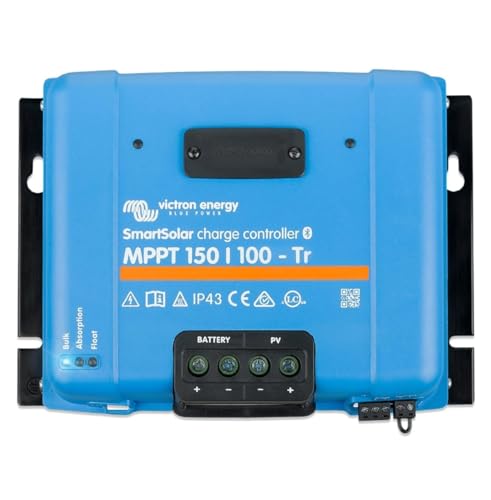
Victron SmartSolar MPPT 100A 150V
Best for: High-current solar systems with Bluetooth monitoring needs
- Rated Output Current
- 100A
- Max PV Input Voltage
- 150V
- Battery System Voltage
- 12/24/36/48V
- Tracking Technology
- MPPT
- Wireless Connectivity
- Bluetooth
- Dimensions
- 11.4 × 13 × 6.3 inches
This Victron Energy controller uses MPPT tracking to maximize power from solar panels, even in shade. It supports 12, 24, 36, and 48V battery systems with a 100A rated output and 150V max PV input. Bluetooth connectivity allows you to monitor performance and configure settings via the VictronConnect app. It also features synchronized charging for multiple units and an intelligent load output to protect batteries from deep discharge.
- 100A rated output current for high-capacity solar arrays
- 150V max PV input voltage allows longer panel strings
- Bluetooth connectivity for real-time monitoring and firmware updates
- Supports 12/24/36/48V battery systems for versatile compatibility
- Synchronized charging capability for multiple controllers
- 11.1 pounds weight is heavier than lighter alternatives
- 150V max input is lower than 250V options available
- 13 inches width is bulkier than compact models
- You need a 100A controller for large solar setups
- You want Bluetooth monitoring without extra hardware
- You use 36V or 48V battery systems
- You require a 250V input for high-voltage panels
- You need a controller under 10 pounds
- You prefer a smaller footprint under 10 inches
Verdict: Victron Energy SmartSolar MPPT 100A 150V suits users who need high current and Bluetooth monitoring. It fits systems requiring 36V or 48V support where weight and size are manageable.

Renogy Rover 100A MPPT Solar Charge Controller
Best for: Large off-grid solar arrays requiring 100A capacity
- Rated Output Current
- 100A
- Max PV Input Voltage
- 150V
- Battery System Voltage
- 12/24/36/48V
- Tracking Technology
- MPPT
- Compatible Battery Types
- AGM, Gel, Flooded, Lithium, LiFePO4
- Intended Use
- Off-Grid
The Renogy Rover 100A is an MPPT solar charge controller designed for off-grid systems. It supports 12V, 24V, 36V, and 48V battery banks with a 150V max PV input. The unit features 99.9% tracking efficiency and handles AGM, Gel, Flooded, and Lithium batteries. It includes TVS lightning protection and an IP32 rated housing. This model suits users needing high current capacity for large solar arrays.
- 99.9% MPPT efficiency for maximum energy harvest
- Supports 12V, 24V, 36V, and 48V systems
- Compatible with AGM, Gel, Flooded, and Lithium batteries
- 100A rated output current for high power loads
- Includes TVS lightning protection and IP32 housing
- Bluetooth module is sold separately for app monitoring
- 100A current rating is lower than 150A alternatives
- IP32 rating offers less weather protection than IP65 units
- You need a 100A controller for large solar arrays
- You use 48V battery systems in off-grid cabins
- You require support for LiFePO4 and lead-acid batteries
- You want built-in Bluetooth without buying extra parts
- You need higher than 100A current capacity
- You require IP65 weatherproofing for harsh marine environments
Verdict: Renogy Rover 100A MPPT Controller fits users who need high current capacity for large off-grid solar arrays. It provides reliable charging for mixed battery types but requires a separate Bluetooth module for wireless monitoring.
Specifications side by side
| Spec | Victron SmartSolar MPPT 100A 150V | Renogy Rover 100A MPPT Solar Charge Controller |
|---|---|---|
| Rated Output Current | 100A | 100A |
| Max PV Input Voltage | 150V | 150V |
| Battery System Voltage | 12/24/36/48V | 12/24/36/48V |
| Tracking Technology | MPPT | MPPT |
| Compatible Battery Types | – | AGM, Gel, Flooded, Lithium, LiFePO4 |
| Wireless Connectivity | Bluetooth | – |
| Intended Use | – | Off-Grid |
| Voltage | 48V | 48V |
| Recommended Use | – | Off-Grid Systems |
| Connectivity | Bluetooth | – |
| Current Rating | 100A | 100A |
| Battery Type | – | AGM, Gel |
| Technology | MPPT | MPPT |
| Operation | – | Manual |
| Dimensions | 11.4 × 13 × 6.3 inches | 12 × 17.4 × 4.35 inches |
| Weight | 11.1 pounds | 22 pounds |
| Color | Blue | Black |
| Model | SCC115110211 | Rover 100 Amp 12/24/36/48V |
| Size | – | 100A MPPT |
Frequently asked questions
Does the Victron SmartSolar come with Bluetooth built-in?
Yes, the Victron Energy SmartSolar MPPT 100A 150V includes integrated Bluetooth connectivity. This feature allows you to monitor and configure the controller directly from a smartphone or tablet without needing extra hardware. You can track system performance in real time through the Victron Connect app.
Can I monitor the Renogy Rover remotely without buying extra parts?
No, the Renogy Rover 100A MPPT Solar Charge Controller does not include built-in wireless monitoring. You must purchase a separate Bluetooth module to enable remote access. Once installed, this add-on allows you to view data and adjust settings via your mobile device.
Which controller is lighter for mobile installations?
The Victron Energy unit is significantly lighter, weighing only 11.1 pounds. In comparison, the Renogy Rover weighs 22 pounds. If you are installing this in a vehicle or portable setup where weight matters, the Victron model offers a much easier installation process.
Do both controllers support 48V battery systems?
Yes, both the Victron SmartSolar and the Renogy Rover support 48V battery systems. They are designed to handle 12V, 24V, 36V, and 48V configurations. This flexibility allows you to use either controller in larger off-grid solar arrays or high-capacity battery banks.
What is the maximum PV input voltage for these units?
Both controllers accept a maximum PV input voltage of 150V. This limit applies to the Victron SmartSolar MPPT 100A 150V and the Renogy Rover 100A. You can connect solar panels that produce up to this voltage, ensuring compatibility with standard high-voltage panel strings.
Are these controllers suitable for AGM and Gel batteries?
Yes, the Renogy Rover explicitly supports AGM and Gel battery types. While the Victron model is also versatile, the Renogy specs confirm compatibility with these common sealed lead-acid batteries. Both units use MPPT technology to optimize charging for various battery chemistries.
Which model is more compact physically?
The Victron Energy controller is more compact, measuring 13 by 11.4 by 6.3 inches. The Renogy Rover is larger, with dimensions of 17.4 by 12 by 4.35 inches. If you have limited space in your electrical cabinet or enclosure, the Victron unit fits more easily.
Is manual operation required for the Renogy controller?
Yes, the Renogy Rover 100A operates manually by default. You must adjust settings using the physical buttons on the device unless you add the Bluetooth module. The Victron model offers similar manual controls but adds the option for wireless configuration via its built-in Bluetooth.


