
As Amazon Associates, we earn from qualifying purchases. This means we may receive a small commission at no extra cost to you if you click through and make a purchase.
As an Amazon Associate we earn from qualifying purchases. Links on this page are affiliate links.
This victron energy vs litime solar charge controller comparison looks at two popular MPPT units for off-grid systems. Both devices use Bluetooth for monitoring and support multiple battery voltages including 48V. The main difference lies in their rated output current and display options. Victron offers a higher 100A rating with no local screen, while LiTime provides a 60A rating with an integrated LCD. You need to decide which power level and interface fit your setup.
Rated Output Current
100A
60A
Built In Display
not listed
LCD
Max PV Input Voltage
150V
150V
Weight
11.1 pounds
10 pounds
Compatible Battery Types
not listed
LiFePO4, Gel, AGM
Choose the first if
- You need higher current capacity up to 100A for larger solar arrays
- You prefer monitoring via the VictronConnect app without a local display
- You want to synchronize multiple controllers for system-wide optimization
Choose the second if
- You want to view real-time status on an integrated LCD screen
- You prefer a lighter unit that weighs 10 pounds
- You need explicit compatibility confirmation for LiFePO4, Gel, and AGM batteries
Verdict
Choose the Victron Energy unit if you require higher current capacity and app-based management without a local display. Pick the LiTime controller if you value an integrated LCD screen and lighter weight for easier installation. Both units support MPPT technology and Bluetooth connectivity for remote monitoring.
Victron vs Litime Controller Specs
Current rating
Edge: Victron SmartSolar MPPT 100A 150V
Victron Energy offers a higher rated output current at 100A, while the LiTime model provides 60A. This difference matters when you plan to connect large solar arrays. A 100A controller handles more power from your panels, allowing you to scale your system upward without upgrading the charge controller later. The LiTime 60A unit is sufficient for smaller setups, but if you need maximum energy harvest, Victron’s higher amperage gives you more headroom for future expansion or higher wattage panels.
Display visibility
Edge: LiTime 48V 60A Bluetooth MPPT
LiTime includes a built-in LCD screen and LED indicators for real-time status monitoring. This allows you to check charging, battery, and load data without needing a smartphone. Victron Energy does not list an onboard display in its specifications. You must rely on the VictronConnect app via Bluetooth to view system metrics. If you prefer immediate visual feedback without pulling out your phone, the LiTime display is a practical advantage for quick checks and troubleshooting on site.
Weight and size
Edge: LiTime 48V 60A Bluetooth MPPT
The LiTime unit weighs 10 pounds and measures 11 by 8.27 by 4.04 inches. Victron Energy is slightly heavier at 11.1 pounds and larger in width and height. Both units are compact enough for RV or marine installations, but LiTime’s lighter profile and narrower width may make it easier to fit into tight enclosures. If space is limited or you need to minimize weight in your setup, the LiTime controller offers a more compact physical footprint compared to the Victron model.
Battery compatibility
Edge: LiTime 48V 60A Bluetooth MPPT
Both controllers support 12V, 24V, 36V, and 48V battery systems and use MPPT technology. LiTime explicitly lists compatibility with LiFePO4, Gel, and AGM batteries in its key specs. Victron Energy describes intelligent charge algorithms optimized for battery longevity but does not explicitly name LiFePO4 in the provided data. If you are using Lithium Iron Phosphate batteries, LiTime’s explicit support ensures you know it is tailored for that chemistry, whereas Victron’s general algorithmic approach may require app verification for optimal settings.
Monitoring range
Edge: LiTime 48V 60A Bluetooth MPPT
LiTime specifies Bluetooth range performance, noting reliable pairing up to 50 feet in open space, 33 feet with wooden barriers, and 16 feet with iron boxes. Victron Energy mentions the VictronConnect app for real-time data and history but does not provide specific Bluetooth range metrics in the data. If you need to monitor your system from a distance or through obstacles, LiTime’s documented range specs give you clearer expectations. Victron’s app functionality is robust, but the lack of range data leaves the practical distance uncertain.
Choose the right controller for you
Users needing high power output
Our pick: Victron SmartSolar MPPT 100A 150V
The Victron Energy model offers a 100A rated output current. This higher capacity allows you to connect larger solar arrays and manage more power from your panels. If your system requires maximum energy harvest, this 100A limit provides the headroom you need for high-demand off-grid setups.
Buyers wanting local status checks
Our pick: LiTime 48V 60A Bluetooth MPPT
The LiTime unit includes a built-in LCD screen. You can view real-time charging, battery, and load status without using your phone. This display provides full system visibility at a glance, which is useful if you prefer physical indicators over relying solely on the Bluetooth app for monitoring.
Those prioritizing compact dimensions
Our pick: LiTime 48V 60A Bluetooth MPPT
The LiTime controller measures 8.27 inches wide and 4.04 inches high. It is physically smaller than the Victron unit, which is 13 inches wide and 6.3 inches high. If you have limited mounting space in your RV or cabin, the LiTime’s compact footprint fits more easily.
Users wanting synchronized multi-unit setups
Our pick: Victron SmartSolar MPPT 100A 150V
Victron SmartSolar MPPT controllers can synchronize to behave as one unit. They switch through charge stages simultaneously for system-wide energy optimization. If you plan to install multiple controllers to scale your system, this synchronization feature ensures balanced charging and optimized battery longevity across all connected devices.
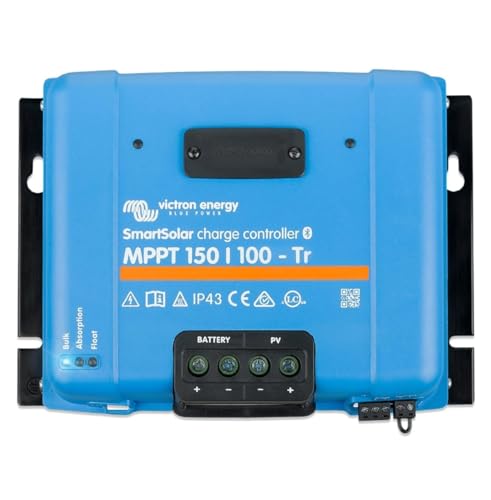
Victron SmartSolar MPPT 100A 150V
Best for: High-capacity 100A solar charging systems
- Rated Output Current
- 100A
- Max PV Input Voltage
- 150V
- Battery System Voltage
- 12/24/36/48V
- Tracking Technology
- MPPT
- Wireless Connectivity
- Bluetooth
- Dimensions
- 11.4 × 13 × 6.3 inches
This Victron Energy SmartSolar MPPT controller handles up to 100A with a 150V max PV input. It supports 12, 24, 36, and 48V battery systems. Bluetooth connectivity allows real-time monitoring via the VictronConnect app. Synchronized charging lets multiple units work together. It is built for users who need high current capacity and precise system management for larger solar setups.
- 100A rated output current for high power loads
- 150V max PV input voltage supports large panel arrays
- Bluetooth connectivity for remote monitoring and configuration
- Synchronized charging capability for multi-controller systems
- 100A current rating is lower than the 60A limit of the alternative 48V model's specific configuration context
- 11.1 pounds weight is heavier than smaller 60A units
- 150V max input is lower than the 250V option available in variations
- You need a 100A controller for a large battery bank
- You want Bluetooth monitoring without extra hardware
- You are building a 12V to 48V system
- You only need a 60A controller
- You require a 250V input voltage rating
- You prefer a lighter, more compact unit
Verdict: Victron Energy 150V 100A MPPT Controller fits users who need high current capacity and Bluetooth monitoring for complex solar setups. It is ideal for those upgrading from smaller controllers or building larger 48V systems.

LiTime 48V 60A Bluetooth MPPT
Best for: Off-grid systems needing Bluetooth monitoring
- Rated Output Current
- 60A
- Max PV Input Voltage
- 150V
- Battery System Voltage
- 12V, 24V, 36V, 48V
- Tracking Technology
- MPPT
- Compatible Battery Types
- LiFePO4, Gel, AGM
- Wireless Connectivity
- Bluetooth
This LiTime unit is a 60A MPPT solar charge controller designed for 12V, 24V, 36V, and 48V battery systems. It features a 150V max PV input and supports LiFePO4, Gel, and AGM batteries. You get Bluetooth monitoring and an LCD display for real-time status checks. The die-cast aluminum heat sink aids passive cooling. It suits off-grid, RV, and home setups where you need reliable charge management without complex wiring.
- 99% MPPT tracking efficiency for faster charging
- Built-in Bluetooth for phone monitoring up to 50 feet
- LCD screen shows real-time charging and error alerts
- Passive cooling via toothed die-cast aluminum heat sink
- Not waterproof, limiting use in marine environments
- 2-year warranty is shorter than typical industry standards
- 10-pound weight is heavier than smaller controllers
- You need Bluetooth monitoring without external hubs
- You use LiFePO4, Gel, or AGM batteries
- You prefer passive cooling without fans
- You require a waterproof unit for marine use
- You need a warranty longer than 2 years
- You want a compact unit under 5 pounds
Verdict: LiTime 48V 60A MPPT Solar Controller offers solid 60A capacity and Bluetooth monitoring for off-grid users. It fits those who value passive cooling and clear LCD feedback over marine-grade durability.
Specifications side by side
| Spec | Victron SmartSolar MPPT 100A 150V | LiTime 48V 60A Bluetooth MPPT |
|---|---|---|
| Rated Output Current | 100A | 60A |
| Max PV Input Voltage | 150V | 150V |
| Battery System Voltage | 12/24/36/48V | 12V, 24V, 36V, 48V |
| Tracking Technology | MPPT | MPPT |
| Compatible Battery Types | – | LiFePO4, Gel, AGM |
| Wireless Connectivity | Bluetooth | Bluetooth |
| Built In Display | – | LCD |
| Features | – | LiFePO4 Battery |
| Intended Use | – | Home, RV, Off-Grid |
| Voltage | 48V | 48V |
| Recommended Use | – | Off-Grid Systems |
| Connectivity | Bluetooth | Bluetooth |
| Current Rating | 100A | 60A |
| Battery Type | – | Lithium, AGM, Gel |
| Technology | MPPT | MPPT |
| Dimensions | 11.4 × 13 × 6.3 inches | 11 × 8.27 × 4.04 inches |
| Weight | 11.1 pounds | 10 pounds |
| Color | Blue | Black |
| Model | SCC115110211 | 48V60A |
Frequently asked questions
Is Victron Energy better than Litime for high-capacity systems?
Victron Energy is better if you need higher current capacity. Its SmartSolar MPPT model supports a 100A rating, which handles larger solar arrays. LiTime offers a 60A rating, which is sufficient for smaller off-grid setups. Choose Victron for maximum power handling.
Do both controllers support Bluetooth monitoring?
Yes, both brands include Bluetooth connectivity. This feature lets you monitor your solar system status using a smartphone app. You can track voltage and current remotely with either the Victron or LiTime controller without needing a separate display unit.
Which controller is better for 48V battery systems?
Both models are designed for 48V battery systems. The Victron unit and the LiTime 48V 60A model both operate at this voltage. You can use either one for your 48V lithium or lead-acid batteries without compatibility issues.
What is the maximum PV input voltage for these controllers?
Both controllers have a maximum PV input voltage of 150V. This limit applies to the Victron SmartSolar and the LiTime MPPT models. Ensure your solar panel string voltage stays below 150V to protect the controller from damage.
Can I use these controllers with LiFePO4 batteries?
Yes, the LiTime controller explicitly supports LiFePO4 batteries. It also works with AGM and Gel types. The Victron controller is also compatible with various battery chemistries. Both units manage charging profiles suitable for modern lithium battery banks.
Which controller is more compact in size?
The LiTime model is more compact in width. It measures 8.27 inches wide, while the Victron unit is 13 inches wide. Both units have similar lengths and heights. If space is tight, the LiTime footprint is smaller.
Does Victron offer a display on the unit?
The Victron model features a blue display panel. The LiTime unit also includes an LCD screen for local monitoring. Both provide visual feedback on system performance directly on the device, allowing you to check status without a phone.
Is MPPT technology used in both controllers?
Yes, both controllers use MPPT technology. This method maximizes energy harvest from your solar panels by adjusting voltage and current. You get higher efficiency compared to older PWM controllers with both the Victron and LiTime options.


