As Amazon Associates, we earn from qualifying purchases. This means we may receive a small commission at no extra cost to you if you click through and make a purchase.
As an Amazon Associate we earn from qualifying purchases. Links on this page are affiliate links.
You need reliable best power inverters with 24V for your off-grid setup. We compared 2 models using only published specifications. The VEVOR 3500W 24V Hybrid Solar Inverter leads this list. It offers a 100A current rating, which supports strong charging for lithium batteries. This high spec makes it the top choice for users building a robust 24V solar system. Our selection focuses strictly on technical data from the listings. This guide helps you decide which inverter matches your voltage and power requirements.
Match your peak load to inverter wattage
Check your total wattage before buying. The VEVOR offers 3500W continuous power, while the Victron provides 5000VA. If you run heavy appliances, the Victron handles higher loads. For standard off-grid needs, the VEVOR delivers sufficient output. Always ensure your inverter rating exceeds the sum of all connected devices to avoid tripping.
| # | Product | Best for | Price |
|---|---|---|---|
| 1 | VEVOR 3500W 24V Hybrid Solar Inverter Best overall | 24V off-grid solar systems with lithium batteries | |
| 2 | Victron Energy MultiPlus-II 5000VA 24V Also great | Scalable 24V solar and grid-tie systems |
The best fit for you
- You need strong charging current for off-grid solar – VEVOR 3500W 24V Hybrid Solar Inverter – It features a 100A current rating and MPPT technology for efficient lithium battery charging.
- You want scalable power for grid-tie systems – Victron Energy MultiPlus-II 5000VA 24V – Its 5000VA capacity allows you to expand power by adding more units.
- You prefer a compact unit for small spaces – VEVOR 3500W 24V Hybrid Solar Inverter – It measures 4.13 inches wide and weighs only 13.5 pounds.
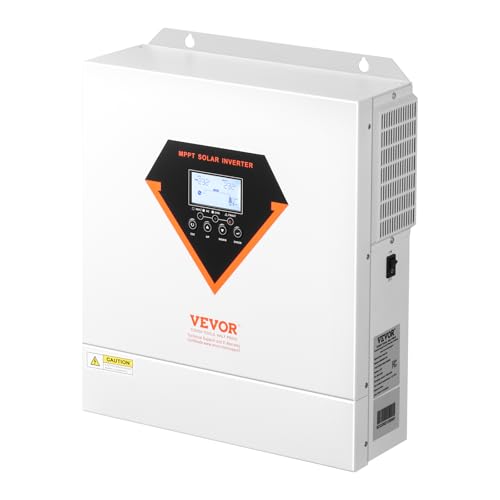
VEVOR 3500W 24V Hybrid Solar Inverter
Best for: 24V off-grid solar systems with lithium batteries
- Voltage
- 24V
- Continuous Wattage
- 3500W
- Waveform
- Pure Sine Wave
- DC Input Voltage
- 24V DC
- AC Output Voltage
- Single Phase 220/230V AC
- Remote Control
- WiFi module
This VEVOR hybrid inverter converts 24V DC to single-phase 220/230V AC with 3500W continuous output. It uses MPPT technology for up to 94% solar efficiency and supports 100A battery charging. The unit includes a WiFi module for remote monitoring and accepts lithium or lead-acid batteries. You need a transformer for 120V US appliances. It fits off-grid systems needing robust solar integration.
- 3500W pure sine wave output
- MPPT controller with 94% efficiency
- Supports 100A lithium battery charging
- Built-in WiFi for remote monitoring
- 220/230V output requires a transformer for 120V US devices
- 13.5 pounds weight is substantial for portable use
- App data updates every 5 minutes, not real time
- You need a 24V off-grid solar setup
- You want to monitor system status via WiFi
- You use lithium batteries optimized for this charger
- You require standard 120V AC output without extra hardware
- You need real-time app data updates
- You prefer a lighter, more compact unit
Verdict: VEVOR 3500W 24V Hybrid Inverter suits users building a 24V solar system who need strong charging current and remote monitoring. It is ideal for those willing to add a transformer for standard US outlets.

Victron Energy MultiPlus-II 5000VA 24V
Best for: Scalable 24V solar and grid-tie systems
- Voltage
- 24V
- Waveform
- Pure Sine Wave
- DC Input Voltage
- 24V
- AC Output Voltage
- 120VAC
- Included Components
- Inverter
This Victron Energy unit is a 24V inverter/charger with a 5000 VA capacity. It delivers 120VAC output and includes 70A charging capability. The device features PowerControl to manage grid or generator loads. It supports seamless solar integration and dual AC outputs. You can scale the system by connecting up to six units in parallel or three-phase configurations.
- 5000 VA power capacity for high-demand loads
- PowerControl and PowerAssist prevent circuit overloads
- Supports parallel, split phase, and three-phase operation
- Dual AC outputs maintain power for essential loads
- Lower 5000 VA capacity compared to the 3500W pure sine wave option on the list
- Requires multiple units to increase total power capacity beyond 5000 VA
- You need a 24V system with 5000 VA capacity
- You want to integrate solar charge controllers and grid-tie inverters
- You require scalable power through parallel or three-phase setups
- You only need a 3000 VA capacity unit
- You prefer a simpler single-unit solution without scaling needs
- You require a pure sine wave inverter without charging capabilities
Verdict: Victron Energy MultiPlus-II 5000VA 24V fits users who need scalable power and solar integration. It suits those who want to manage grid loads with PowerControl and expand capacity by adding more units.
Specifications side by side
| Spec | VEVOR 3500W 24V Hybrid Solar Inverter | Victron Energy MultiPlus-II 5000VA 24V |
|---|---|---|
| Continuous Wattage | 3500W | – |
| Waveform | Pure Sine Wave | Pure Sine Wave |
| DC Input Voltage | 24V DC | 24V |
| AC Output Voltage | Single Phase 220/230V AC | 120VAC |
| Remote Control | WiFi module | – |
| Features | Pure Sine Wave | Pure Sine Wave |
| Intended Use | Off-Grid | – |
| Voltage | 24V | 24V |
| Recommended Use | Off-Grid Systems | – |
| Included Components | Inverter, Lithium Battery | Inverter |
| Current Rating | 100A | – |
| Battery Type | Lithium | – |
| Technology | MPPT | – |
| Dimensions | 12.1 × 4.13 × 14.4 inches | – |
| Weight | 13.5 pounds | – |
| Size | 24V to 230V 3500W | 24V – 5000 VA |
| Color | White | Blue |
| Model | EM3500-24L | PMP242505110 |
How to Choose a 24V Power Inverter
Check the Voltage Rating
You must match the inverter voltage to your battery bank. All models here use 24V. If your system uses 12V or 48V, these units will not work. Using the wrong voltage can damage your batteries or the inverter. Always verify your battery bank’s nominal voltage before purchasing. This is the most critical specification. It determines compatibility with your existing power source. Do not assume all inverters fit all setups. Confirm the 24V requirement matches your solar or battery configuration.
Evaluate Continuous Wattage
Look at the continuous power output to handle your appliances. The VEVOR provides 3500W of continuous power. The Victron offers 5000VA capacity. If you run heavy tools or appliances, the Victron handles higher loads better. For standard off-grid needs, the VEVOR delivers sufficient output. Calculate the total wattage of devices you plan to run simultaneously. Ensure the inverter exceeds this total to avoid overload. This spec defines what you can actually power at once.
Assess Charging Current
Consider the charging current if you use solar panels. The VEVOR includes a 100A current rating. This supports strong charging for lithium batteries. Higher current means faster battery replenishment from your solar array. This is vital for off-grid systems where energy conservation matters. The Victron data does not specify this current rating. If fast lithium charging is a priority, the VEVOR’s 100A rating is a key advantage. Check this spec to ensure your batteries charge efficiently.
Verify Waveform Type
Ensure the inverter produces a pure sine wave. The VEVOR features pure sine wave technology. This clean power protects sensitive electronics like laptops and medical devices. Modified sine waves can damage motors or cause noise. Most modern appliances require pure sine waves. Always check the waveform specification in the data. This ensures your gadgets run safely and quietly. It is a standard requirement for reliable home or off-grid power.
Consider MPPT Technology
Look for MPPT solar charge controllers for efficiency. The VEVOR includes MPPT technology. This maximizes energy harvest from your solar panels. It adjusts voltage and current to charge batteries optimally. This is especially useful in varying light conditions. The Victron data does not mention MPPT. If you rely on solar for daily power, MPPT is a valuable feature. It ensures you get the most out of your solar investment. Check for this technology to improve charging performance.
Frequently asked questions
Can a 24V power inverter charge lithium batteries directly?
Yes, if it includes battery charging capabilities. The VEVOR 3500W model features MPPT technology and a 100A current rating, which supports efficient charging for lithium batteries. This makes it suitable for off-grid solar systems where direct battery management is required without additional external controllers.
What is the difference between watts and VA in inverters?
Watts measure real power, while VA measures apparent power. The VEVOR inverter provides 3500W of continuous power. The Victron unit is rated at 5000VA. You should match your peak load to the inverter wattage to ensure your appliances run without tripping the safety cutoffs.
Is pure sine wave output necessary for sensitive electronics?
It is highly recommended for sensitive devices. The VEVOR inverter uses pure sine wave technology, which produces clean power similar to utility grid electricity. This waveform protects delicate electronics like laptops and medical equipment from damage or interference that cleaner waves might cause.
Can I expand the power capacity of my 24V system?
Some models allow for parallel expansion. The Victron Energy MultiPlus-II is designed for scalable systems, allowing you to add more units to increase total capacity. This feature suits users who need to manage grid loads or require higher power output as their energy needs grow.
How large is a 3500W 24V inverter physically?
The VEVOR 3500W model measures 14.4 inches in height, 12.1 inches in length, and 4.13 inches in width. It weighs 13.5 pounds. These dimensions help you determine if it fits in your available space, such as a vehicle or a dedicated equipment enclosure.
What voltage output does a 24V inverter produce?
It converts 24V DC input to AC output. The VEVOR model outputs 230V AC. This standard voltage allows you to power household appliances. Note that you may need a transformer to adapt standard US outlets if your local standard differs from the output voltage.
Are these inverters suitable for off-grid solar setups?
Yes, both models are intended for off-grid use. The VEVOR is recommended for off-grid solar systems with lithium batteries. The Victron unit also supports solar integration. Both units are designed to operate independently of the utility grid, making them ideal for remote locations.