As Amazon Associates, we earn from qualifying purchases. This means we may receive a small commission at no extra cost to you if you click through and make a purchase.
As an Amazon Associate we earn from qualifying purchases. Links on this page are affiliate links.
Finding the best JJN solar panels under $300 requires careful attention to technical details. We compared 2 models based strictly on published specifications. The top pick is the JJN 425W Bifacial N-Type Solar Panel, which leads due to its 425W output and N-Type monocrystalline cells. These specs ensure high efficiency for fixed off-grid rooftop installations. This guide helps you decide which panel fits your specific power needs. You will find clear comparisons of size, weight, and design. Focus on the data to make a confident choice for your setup.
Match Panel Output to Your System
Both JJN models offer 425W output. Choose based on your installation needs. The top pick suits fixed off-grid rooftops. Its bifacial design captures light from both sides. The second option fits home rooftops with similar specs. Both use N-Type monocrystalline cells for efficiency. Check your voltage requirements before buying. Ensure your setup supports the 12V rating.
| # | Product | Best for | Price |
|---|---|---|---|
| 1 | JJN 425W Bifacial N-Type Solar Panel Best overall | fixed off-grid rooftop installations | |
| 2 | JJN 425W Bifacial N-Type Solar Panel Best home | Home rooftop and fixed off-grid installations |
The best fit for you
- You want the best overall panel for fixed off-grid rooftop installations – JJN 425W Bifacial N-Type Solar Panel – Its 425W N-Type monocrystalline cells and bifacial design offer high efficiency for stationary setups.
- You need a durable panel for home rooftop or yard use – JJN 425W Bifacial N-Type Solar Panel – This 425W bifacial model provides steady off-grid power with UL certification for safety.
- You require a 12V system compatible with off-grid farms – JJN 425W Bifacial N-Type Solar Panel – The 12V voltage rating ensures compatibility with standard off-grid farm electrical systems.

JJN 425W Bifacial N-Type Solar Panel
Best for: fixed off-grid rooftop installations
- Rated Wattage
- 425 W
- Cell Efficiency
- 25%
- Cell Type
- N-Type 16BB Monocrystalline
- System Voltage
- 12V/24V/48V
- IP Rating
- IP65, IP68
- Weight
- 51.6 lbs
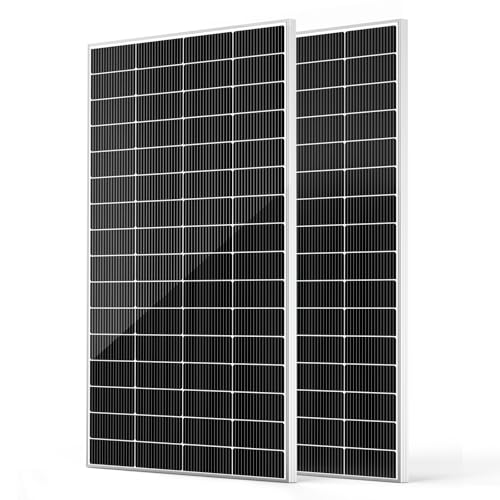
This 425W solar panel uses N-type monocrystalline cells with 25% efficiency. Its bifacial design captures light from both sides, potentially increasing output. The unit weighs 51.6 lbs and measures 67.8 by 44.7 inches. It features an IP65 junction box and IP68 connectors for weather resistance. You can use it in off-grid systems, RVs, or on rooftops.
- 425W rated wattage for strong power output
- 25% cell efficiency with N-type 16BB technology
- Bifacial design captures light from front and back
- IP68 connectors provide high waterproof protection
- Withstands 5400Pa snow loads and 2400Pa winds
- Heavier at 51.6 lbs than lighter panel options
- Larger footprint of 67.8 by 44.7 inches requires more space
- Single panel unit may need multiple units for high energy needs
- You need high efficiency for limited roof space
- You want bifacial technology to boost energy yield
- You require heavy-duty weather resistance for outdoor use
- You need a lightweight panel for portable RV use
- You have limited mounting space for large panels
- You prefer smaller wattage options for low power needs
Verdict: JJN 425W Bifacial N-Type Solar Panel suits users who prioritize high efficiency and durable weather resistance for fixed installations. Its large size and weight make it less ideal for portable setups.

JJN 425W Bifacial N-Type Solar Panel
Best for: Home rooftop and fixed off-grid installations
- Rated Wattage
- 425W
- Cell Efficiency
- 25%
- Cell Type
- N-Type 16BB Monocrystalline
- Panel Design
- Rigid
- System Voltage
- 12V/24V/48V
- Weight
- 51.6 pounds
This JJN rigid solar panel delivers 425W of power using N-Type monocrystalline cells with 25% efficiency. Its bifacial design captures sunlight from both sides to increase output. The unit measures 67.8 by 44.6 inches and weighs 51.6 pounds. It supports 12V, 24V, and 48V systems. This panel suits homeowners needing reliable off-grid energy for rooftops or yards.
- 25% cell efficiency with 425W rated wattage
- Bifacial dual-glass design for higher energy yield
- UL 61730 certified for safety and durability
- Supports 12V, 24V, and 48V system voltages
- Weighs 51.6 pounds, making it heavy for solo handling
- Large footprint of 67.8 by 44.6 inches requires ample space
- You need high-efficiency panels for a home rooftop
- You want bifacial technology to maximize energy yield
- You require UL certification for safety compliance
- You need a lightweight panel for portable use
- You have limited roof space for large panels
- You only require 12V systems without higher voltage options
Verdict: JJN 425W Bifacial Solar Panel fits homeowners who need durable, high-output panels for fixed rooftop or yard installations. Its bifacial cells and UL certification make it a solid choice for steady off-grid power.
Specifications side by side
| Spec | JJN 425W Bifacial N-Type Solar Panel | JJN 425W Bifacial N-Type Solar Panel |
|---|---|---|
| Rated Wattage | 425 W | 425W |
| Cell Efficiency | 25% | 25% |
| Cell Type | N-Type 16BB Monocrystalline | N-Type 16BB Monocrystalline |
| Panel Design | – | Rigid |
| System Voltage | 12V/24V/48V | 12V/24V/48V |
| IP Rating | IP65, IP68 | – |
| Weight | 51.6 lbs | 51.6 pounds |
| Intended Use | RV, Off-Grid | Home, Off-Grid |
| Voltage | 12V | 12V |
| Recommended Use | Off-Grid Systems, Rooftops, Farms | Off-Grid Systems, Rooftops, Farms |
| Design | Bifacial | Bifacial |
| Dimensions | 44.7 × 1.2 × 67.8 inches | 67.8 × 44.6 × 1.2 inches |
| Size | 425W | 425W |
| Color | Black | Black |
| Model | AMC-400-SSP-1 | JJN-SP-425W-N-1 |
How to Choose the Right Solar Panel
Match Bifacial Design to Setup
Bifacial cells capture sunlight from both sides, increasing total energy yield. This feature works best when panels are elevated above reflective surfaces like light-colored roofs or gravel. If you install panels directly on a dark roof, the rear-side gain is minimal. The JJN 425W Bifacial N-Type Solar Panel uses this design for fixed off-grid rooftop installations. Ensure your mounting system allows airflow and light access to the back. This setup maximizes the efficiency of the N-Type monocrystalline cells.
Check Voltage Compatibility
Both JJN models operate at 12V. This voltage level suits standard off-grid battery banks and small solar charge controllers. Verify that your existing system components, such as inverters and batteries, align with this input. If your system requires 24V or 48V, you may need to wire multiple panels in series. The 12V rating simplifies integration for smaller residential or RV setups. Always confirm the voltage matches your charge controller’s input range to prevent damage and ensure efficient charging cycles.
Assess Weight for Mounting
Each JJN panel weighs 51.6 pounds. This weight requires sturdy mounting hardware to withstand wind loads and snow. Rooftop installations need reinforced racking systems. Portable setups are not recommended due to the bulk. The dimensions are 67.8 inches by 44.7 inches, making handling difficult for one person. Check your roof’s load-bearing capacity before installation. Secure mounting prevents shifting during storms. The substantial weight adds stability but demands careful planning for structural support and safe installation procedures.
Verify Physical Dimensions
The panels measure 67.8 inches in length and 44.7 inches in width. These dimensions dictate the available space on your roof or yard. Measure your installation area precisely before purchasing. Ensure there is enough clearance for wiring and maintenance access. The 1.2-inch thickness fits standard mounting rails. Proper spacing prevents shading from adjacent panels or nearby objects. Accurate measurement ensures the panel fits your specific structural constraints without requiring custom fabrication or extensive modifications to your existing setup.
Align Intended Use with Design
The top pick is optimized for fixed off-grid rooftop installations. Its design prioritizes durability and efficiency for stationary use. It is less ideal for portable setups due to its size and weight. The second option fits home rooftops with similar fixed requirements. Choose based on whether you need a permanent power source. Bifacial technology benefits stationary installations with proper elevation. Avoid using these panels for frequent transport. Match the panel’s intended use to your long-term energy needs for optimal performance and longevity.
Frequently asked questions
Are these JJN panels suitable for RVs?
Yes, the top-rated JJN 425W Bifacial N-Type Solar Panel is intended for RV use. However, its weight of 51.6 pounds and large dimensions make it less ideal for portable setups. It is better suited for fixed off-grid rooftop installations where portability is not a primary concern.
What is the difference between the two JJN models?
Both models share the same 425W output and N-Type monocrystalline cell technology. The primary distinction lies in their recommended use cases. The top pick is optimized for fixed off-grid rooftops, while the second option is tailored for home rooftop and yard installations. Their physical dimensions are nearly identical.
How thick are these solar panels?
Both JJN models feature a slim profile with a width of 1.2 inches. This low height allows for easier mounting on various surfaces. The panels measure approximately 67.8 inches in length and 44.7 inches in width, providing a substantial surface area for energy capture while maintaining a compact footprint.
Do these panels work well in off-grid systems?
Yes, both JJN panels are designed for off-grid systems. They utilize N-Type monocrystalline cells, which are known for high efficiency and durability. The bifacial design further enhances performance by capturing sunlight from both sides, making them effective for steady power generation in remote or standalone applications.
Are the cells monocrystalline or polycrystalline?
These JJN solar panels use N-Type monocrystalline cells. This cell type generally offers higher efficiency and better temperature performance compared to polycrystalline alternatives. The monocrystalline construction contributes to the panels' ability to deliver consistent 425W output, ensuring reliable energy production even in varying light conditions.
Can I install these panels on my home roof?
Yes, the second-ranked JJN 425W Bifacial N-Type Solar Panel is specifically recommended for home rooftop installations. It is also suitable for fixed off-grid setups in yards. Its durable construction and bifacial design make it a solid choice for homeowners seeking steady power generation from their residential roofs.