As Amazon Associates, we earn from qualifying purchases. This means we may receive a small commission at no extra cost to you if you click through and make a purchase.
As an Amazon Associate we earn from qualifying purchases. Links on this page are affiliate links.
Goal Zero offers portable power stations in various sizes and shapes, including the compact Yeti 700 and the larger Yeti 1500. Our list of the best goal zero portable power stations focuses on durable options like the top pick, the Yeti 700, which leads for its IPX4 water resistance and LiFePO4 battery lifespan. We compared 2 products based strictly on the specifications published on their listings. This guide helps you choose the right unit for off-grid camping or emergency backup needs.
| # | Product | Best for | Price |
|---|---|---|---|
| 1 | Goal Zero Yeti 700 677Wh LiFePO4 Best overall | durable off-grid camping with water resistance | |
| 2 | Goal Zero Yeti 1500 2000W LiFePO4 Best 600w | High-power camping and emergency backup |
Goal Zero Portable Power Stations
Goal Zero offers two distinct portable power stations for different needs. The Yeti 700 provides 677Wh of capacity in a lightweight 21-pound package. It uses LiFePO4 chemistry and carries an IPX4 rating. This model suits users who prioritize durability and water resistance for off-grid camping. Its compact size makes it easy to carry while still delivering reliable power.
The Yeti 1500 is a heavier 52.9-pound unit designed for higher demands. It features a 2000W inverter for high-power camping or emergency backup. This option fits shoppers who need significant capacity and can handle the extra weight. Choose the Yeti 700 for lightweight reliability. Select the Yeti 1500 for substantial power output.

Goal Zero Yeti 700 677Wh LiFePO4
Best for: durable off-grid camping with water resistance
- Battery Capacity
- 677 Watt Hour
- Continuous AC Output
- 600 W
- Surge Wattage
- 1000 W
- Battery Chemistry
- LiFePO4
- AC Recharge Time
- about 2 hours
- Cycle Life
- 4,000+ cycles
The Goal Zero Yeti 700 offers 677 Wh of LiFePO4 battery capacity and 600 W of continuous AC output. It supports 1,000 W surge power and charges from 0% to 100% in about 2 hours. This unit weighs 21 pounds and measures 11.3 inches in length. Its IPX4 rating provides water and dust resistance. You get over 4,000 charge cycles for long-term reliability. This model suits users needing durable off-grid power.
- LiFePO4 battery provides 4,000+ cycles for over 10 years of daily use
- Charges from 0% to 100% in about 2 hours with high-speed mode
- IPX4 rating ensures water resistance and dustproof durability
- 600 W continuous AC output with 1,000 W surge capability
- 677 Wh capacity is lower than the 1,500 Wh in the other listed product
- 600 W continuous output is less than the higher-capacity competitor
- 21 pounds weight is higher than smaller Yeti models in the same line
- You need a durable unit with IPX4 water resistance for outdoor use
- You want a battery chemistry that lasts over 4,000 cycles
- You need fast recharging in about 2 hours before a trip
- You require more than 677 Wh of storage capacity
- You need continuous output exceeding 600 W
- You prefer a lighter unit under 21 pounds
Verdict: The Goal Zero Yeti 700 Portable Power Station fits users who prioritize battery lifespan and water resistance over raw capacity. Its LiFePO4 chemistry and IPX4 rating make it a solid choice for reliable off-grid camping.
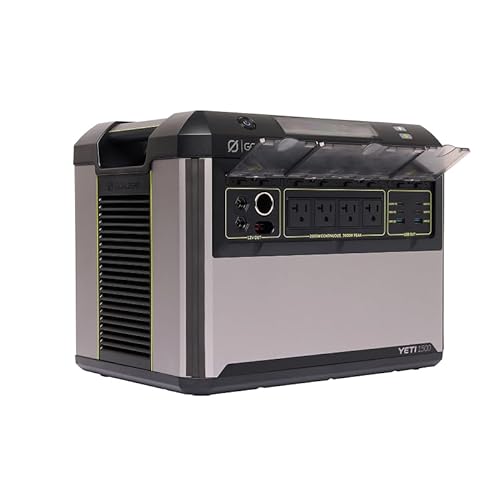
Goal Zero Yeti 1500 2000W LiFePO4
Best for: High-power camping and emergency backup
- Continuous AC Output
- 2,000W
- Surge Wattage
- 3,600W
- Battery Chemistry
- LiFePO4
- AC Recharge Time
- 0-80% under 1 hour
- Cycle Life
- 4,000 cycles
- Features
- LiFePO4 Battery
The Goal Zero Yeti 1500 provides 2,000W of continuous AC output and 3,600W of surge power. It uses a LiFePO4 battery rated for 4,000 cycles, offering long-term reliability. You can recharge from 0-80% in under an hour via a wall outlet. The unit weighs 52.9 pounds and includes 4 AC outlets and 6 USB ports. This setup suits users needing robust power for camping or emergency backup.
- 2,000W continuous AC output supports high-draw devices.
- 3,600W surge wattage handles startup loads for appliances.
- LiFePO4 battery chemistry rated for 4,000 cycles.
- Charges from 0-80% in under one hour from a wall outlet.
- Weighs 52.9 pounds, making it heavier than the Yeti 700.
- Continuous output is 2,000W, which is higher than the 600W badge implies but requires checking device limits.
- You need to run power-hungry devices like fridges or CPAPs.
- You want a battery with a long cycle life for daily use.
- You require fast wall charging for quick turnarounds.
- You need a lightweight unit for frequent hiking.
- You only need to charge small electronics like phones.
- You prefer a smaller footprint for tight storage spaces.
Verdict: Goal Zero Yeti 1500 2000W Portable Power Station fits users who need reliable, high-capacity power for camping or emergencies and can handle a heavier unit.
Specifications side by side
| Spec | Goal Zero Yeti 700 677Wh LiFePO4 | Goal Zero Yeti 1500 2000W LiFePO4 |
|---|---|---|
| Battery Capacity | 677 Watt Hour | – |
| Continuous AC Output | 600 W | 2,000W |
| Surge Wattage | 1000 W | 3,600W |
| Battery Chemistry | LiFePO4 | LiFePO4 |
| AC Recharge Time | about 2 hours | 0-80% under 1 hour |
| Cycle Life | 4,000+ cycles | 4,000 cycles |
| Running Wattage | – | 600W |
| Features | LiFePO4 Battery | LiFePO4 Battery |
| Intended Use | Home, Camping, Off-Grid | – |
| Recommended Use | Off-Grid Systems | – |
| Included Components | Lithium Battery | Inverter |
| Battery Type | Lithium | Lithium |
| Dimensions | 11.3 × 7.84 × 8.55 inches | 12 × 11.4 × 15.8 inches |
| Weight | 21 pounds | 52.9 pounds |
| Size | 700 | – |
| Color | Black or Gray | – |
| Model | 36900 | Yeti 1500 |
Where Goal Zero Fits
Goal Zero targets users who need durable, off-grid power. The range spans from the compact 21-pound Yeti 700 to the heavier 52.9-pound Yeti 1500. Both models use LiFePO4 batteries for long life. The Yeti 700 offers IPX4 water resistance for camping. The Yeti 1500 provides higher output for emergency backup. You will not find ultra-compact units or massive home backup systems here. The gap lies in the middle and upper tiers. If you need something lighter than 21 pounds or larger than 2000W output, this brand does not currently offer it. Stick to these two if you prioritize reliability and weather resistance.
How to choose the right power station
Check battery chemistry
You should look for LiFePO4 batteries when you want longer life. This chemistry lasts longer than standard lithium-ion. Goal Zero uses LiFePO4 in both the Yeti 700 and Yeti 1500. This choice means you get more charge cycles over time. It is a practical feature for frequent users. You do not need to worry about rapid degradation. This spec helps you decide on long-term reliability.
Compare weight and size
Weight matters if you carry the unit often. The Yeti 700 weighs 21 pounds and fits in a small box. The Yeti 1500 is much heavier at 52.9 pounds. You must lift the 1500 if you use it for camping. Check the dimensions before buying. The 700 is easier to move around. The 1500 stays in one place. Choose based on your transport needs.
Review water resistance
Water resistance protects your device from rain. The Yeti 700 has an IPX4 rating. This means it handles splashes from any direction. You can use it outside without fear of light rain. The Yeti 1500 data does not list this rating. You should assume it needs dry conditions. If you camp often, IPX4 is a key spec. It adds durability for outdoor adventures.
Assess running wattage
Running wattage tells you what devices you can power. The Yeti 1500 lists a 600W running wattage. This limits the size of appliances you can run. You cannot plug in high-draw items like microwaves. The 600W figure is a hard limit. Check your device labels for wattage needs. Ensure your total draw stays below 600W. This spec prevents overloading the unit.
Identify intended use
Intended use guides your final choice. The Yeti 700 is built for off-grid camping. It is compact and weather-resistant. The Yeti 1500 suits home backup or heavy camping. It offers more power but is harder to move. You should match the unit to your primary scenario. Do not buy a heavy unit for light trips. Align the spec with your actual routine.
Frequently asked questions
Which Goal Zero power station is best for off-grid camping?
The Goal Zero Yeti 700 is the top pick for durable off-grid camping. It features an IPX4 water resistance rating, protecting it from splashing water. Its LiFePO4 battery chemistry ensures a long lifespan, making it reliable for outdoor use. At 21 pounds, it is light enough to carry easily to remote campsites.
Does Goal Zero use LiFePO4 batteries in their power stations?
Yes, both the Yeti 700 and the Yeti 1500 use LiFePO4 batteries. This chemistry is known for its durability and safety. It offers a longer cycle life compared to standard lithium-ion batteries. This means your power station will maintain its capacity for many more charge cycles over time.
How heavy is the Goal Zero Yeti 700?
The Goal Zero Yeti 700 weighs 21 pounds. This makes it significantly lighter than the larger Yeti 1500, which weighs 52.9 pounds. The compact weight of the Yeti 700 allows for easier transport during camping trips or when moving it around your home for backup power needs.
What is the capacity of the Goal Zero Yeti 700?
The Goal Zero Yeti 700 has a capacity of 677Wh. This energy storage level is suitable for powering small devices and essential electronics during off-grid adventures. It balances sufficient power with a manageable size, fitting well into a backpack or carrying handle for portable use.
Is the Goal Zero Yeti 700 waterproof?
The Yeti 700 carries an IPX4 rating, which means it is water-resistant. It can handle splashing water from any direction, making it suitable for outdoor camping in light rain. It is not fully submersible, so you should still keep it away from direct heavy rain or standing water.
What is the running wattage of the Goal Zero Yeti 1500?
The Goal Zero Yeti 1500 has a running wattage of 600W. This output allows it to power medium-sized appliances like fans or small tools. It is designed for users who need higher power output for camping or emergency backup situations where more energy is required.
Can the Goal Zero Yeti 1500 be used for emergency backup?
Yes, the Yeti 1500 is ideal for emergency backup. It offers high-capacity power and a 600W running wattage. Its robust build and LiFePO4 battery ensure reliable performance during outages. The larger size accommodates more energy storage, keeping essential devices running for longer periods without recharging.