
As Amazon Associates, we earn from qualifying purchases. This means we may receive a small commission at no extra cost to you if you click through and make a purchase.
As an Amazon Associate we earn from qualifying purchases. Links on this page are affiliate links.
The AMPINVT 120A MPPT Solar Charge Controller handles high-capacity 48V systems with a 120A output and 150V max PV input. It offers an LCD display for real-time monitoring and supports multiple battery types. You might seek ampinvt 120a mppt solar charge alternatives if you need lower amperage for smaller RV setups or prefer built-in wireless connectivity over separate modules. Some users also find the original’s physical dimensions too large for their installation space.
The 6 alternatives listed here were chosen because their specs overlap with the original product. This list includes options with 60A or 100A ratings, which suit moderate-sized arrays. Several models feature integrated Bluetooth or Wi-Fi for easier remote monitoring. Others prioritize compact sizes or specific voltage configurations like 48V support. Each option maintains MPPT technology to ensure efficient power conversion. You can compare these specs to find the right fit for your solar array size and monitoring needs.
How the alternatives compare
Renogy Rover Lite 60A MPPT
The Renogy Rover Lite 60A MPPT drops the amperage from 120A to 60A, making it suitable for smaller RV or off-grid setups rather than large arrays. It retains the 150V max PV input and MPPT technology found in the AMPINVT model. You give up the higher current capacity but gain a more compact form factor and automatic voltage detection. This controller supports Lithium, AGM, and Gel batteries. It is a practical choice if you prioritize cost over maximum amperage and do not need to support 48V systems with high wattage loads.
LiTime 60A MPPT Bluetooth Controller
The LiTime 60A MPPT Bluetooth Controller offers built-in Bluetooth connectivity, which the AMPINVT model requires an additional purchase to achieve. Like the original, it supports 150V max PV input and MPPT technology. However, it limits output to 60A, which is half the capacity of the AMPINVT. It is designed for series panel setups and includes LiFePO4 battery support. You trade raw power for the convenience of remote monitoring via smartphone. This model is ideal for users who need wireless control but do not require the high current capacity of a 120A system.
LiTime 48V 60A Bluetooth MPPT
The LiTime 48V 60A Bluetooth MPPT Controller supports 48V systems like the AMPINVT, but it caps output at 60A. It includes built-in Bluetooth for smartphone monitoring, removing the need for extra hardware. It shares the 150V max PV input and MPPT technology. You gain easy remote access to system data but lose the higher amperage needed for large solar arrays. It supports Lithium, AGM, and Gel batteries. This controller is best for home or RV off-grid setups where remote monitoring is essential and the lower current rating is sufficient for your energy needs.
EPEVER Tracer 100A MPPT Controller
The EPEVER Tracer 100A MPPT Controller provides 100A of charging current, which is slightly less than the AMPINVT’s 120A but more than most competitors. It supports 150V max PV input and MPPT technology. A key difference is its support for MODBUS, allowing for wired system expansion and integration with larger monitoring systems. It does not include built-in wireless connectivity. You trade the highest possible amperage for robust industrial-grade connectivity options. This controller fits users who prioritize high current handling and wired expansion over mobile app monitoring or the absolute maximum output capacity.
GCSOAR 100A MPPT Controller with WiFi
The GCSOAR 100A MPPT Controller with WiFi includes built-in Wi-Fi for remote app control, a feature the AMPINVT model requires an extra purchase to enable. It offers 100A of output, which is close to the AMPINVT’s 120A capacity. It supports MPPT technology and LiFePO4 batteries. You gain immediate wireless monitoring capabilities but sacrifice 20A of peak current. The controller is heavier at 8.82 pounds. It is a strong option for users who need high power and want remote app control without purchasing additional communication modules or adapters.
Renogy Rover 100A MPPT Solar Charge Controller
The Renogy Rover 100A MPPT Controller offers 100A of output, slightly less than the AMPINVT’s 120A, but supports 48V systems. It features automatic system detection and manual operation. It retains the 150V max PV input and MPPT technology. Unlike the AMPINVT, it does not include built-in Wi-Fi or Bluetooth. You gain rugged durability and automatic voltage detection but lose the highest amperage and wireless connectivity. This controller is suitable for users who need high current capacity and reliable automatic detection for off-grid systems, prioritizing efficiency and build quality over remote monitoring features.
| # | Product | Best for | Price |
|---|---|---|---|
| 1 | Ampinvt 120A MPPT Solar Charge Controller Best overall | High-capacity 48V solar systems | |
| 2 | Renogy Rover Lite 60A MPPT Best budget | smaller off-grid and RV solar systems | |
| 3 | LiTime 60A MPPT Bluetooth Controller Also great | series panel setups with Bluetooth monitoring needs | |
| 4 | LiTime 48V 60A Bluetooth MPPT Best home | Bluetooth monitoring and home off-grid use | |
| 5 | EPEVER Tracer 100A MPPT Controller Also great | High-capacity solar systems needing 100A charging | |
| 6 | GCSOAR 100A MPPT Controller with WiFi Best remote control | high-power solar systems needing remote app control | |
| 7 | Renogy Rover 100A MPPT Solar Charge Controller Best manual | High-current off-grid systems requiring automatic detection |

Ampinvt 120A MPPT Solar Charge Controller
Best for: High-capacity 48V solar systems
- Rated Output Current
- 120A
- Max PV Input Voltage
- 150V
- Battery System Voltage
- 12V 24V 36V 48V
- Tracking Technology
- MPPT
- Compatible Battery Types
- Gel, Sealed, Flooded, Lithium
- Built In Display
- LCD
The AMPINVT 120A MPPT Solar Charge Controller handles up to 150V PV input with a 120A rated output. It supports 12V, 24V, 36V, and 48V battery systems. The LCD display shows real-time energy stats. You get four charging options including lithium. This unit suits high-capacity solar setups needing robust current handling.
- 120A rated output current for high-power systems
- Supports 12V, 24V, 36V, and 48V battery voltages
- 150V max PV input voltage
- LCD display for real-time monitoring
- Compatible with Gel, Sealed, Flooded, and Lithium batteries
- 150V max input is lower than the 200V found on some competitors
- Physical dimensions of 17.2 inches height make it bulkier than compact 60A models
- Wi-Fi monitoring requires an additional purchase rather than being built-in
- You need a 120A controller for large solar arrays
- You use 48V battery systems requiring high current
- You want clear LCD data without relying solely on an app
- You require a controller with built-in Wi-Fi
- You need a max PV input voltage above 150V
- You prefer a compact unit under 10 inches tall
Verdict: AMPINVT 120A MPPT Solar Charge Controller fits users with large solar arrays needing 120A capacity and 48V support. It offers solid monitoring via LCD but requires extra hardware for wireless features.

Renogy Rover Lite 60A MPPT
Best for: smaller off-grid and RV solar systems
- Rated Output Current
- 60A
- Max PV Input Voltage
- 150V
- Battery System Voltage
- 12V, 24V, 36V, 48V
- Tracking Technology
- MPPT
- Compatible Battery Types
- LiFePO4, AGM, Gel, Flooded
- Built In Display
- Backlit display
The Renogy Rover Lite 60A MPPT Solar Charge Controller handles 12V, 24V, 36V, and 48V systems with a 150V max PV input. It supports LiFePO4, AGM, Gel, and Flooded batteries. The unit features a backlit display and operates from 31°F to 113°F. You get automatic system detection and tool-free installation. Bluetooth monitoring requires a separate module.
- Supports six panels in series via 150V max input
- Auto-detects 12V, 24V, 36V, and 48V battery systems
- Backlit display shows real-time charging data
- Operates in temperatures from 31°F to 113°F
- Includes overvoltage and short-circuit protection
- 60A rated output is lower than the 100A and 120A options on this list
- Bluetooth monitoring module is sold separately
- You need a budget-friendly MPPT controller for smaller solar arrays
- You want automatic voltage detection for mixed battery types
- You plan to connect multiple panels in series
- You require a higher current rating than 60A
- You need built-in Bluetooth without purchasing extra parts
- You want a controller with a 120A capacity
Verdict: Renogy Rover Lite 60A MPPT Controller fits users who need reliable 150V input support and automatic voltage detection for moderate-sized off-grid or RV setups. It is a practical option when you prioritize cost over maximum amperage.

LiTime 60A MPPT Bluetooth Controller
Best for: series panel setups with Bluetooth monitoring needs
- Rated Output Current
- 60A
- Max PV Input Voltage
- 150V
- Battery System Voltage
- 12V-48V
- Tracking Technology
- MPPT
- Compatible Battery Types
- LiFePO4, Gel, AGM
- Wireless Connectivity
- Bluetooth
This LiTime unit is a 60A MPPT solar charge controller supporting 12V to 48V battery systems. It features a 150V max PV input, allowing you to connect up to six panels in series. Built-in Bluetooth lets you monitor status on your phone. The LCD display shows real-time charging data. It works with LiFePO4, Gel, and AGM batteries. The device operates from -31°F to 113°F. It is suitable for RV and off-grid use.
- 60A rated output current for reliable charging
- 150V max PV input supports series panel arrays
- Built-in Bluetooth for remote monitoring via phone
- LCD screen displays real-time system status
- 97% conversion efficiency for effective power use
- 60A output is lower than the 100A options on this list
- 150V max input is lower than the 200V and 150V limits of competitors
- Not waterproof, limiting use in marine environments
- You need Bluetooth monitoring for your solar setup
- You want to connect multiple panels in series
- You use LiFePO4 or AGM battery systems
- You require waterproof protection for marine use
- You need more than 60A of charging current
- You want to connect panels above 150V input
Verdict: LiTime 60A MPPT Bluetooth Controller fits users who prioritize remote monitoring and series panel compatibility over raw amperage. It is a solid choice for RV and off-grid systems where Bluetooth connectivity is essential.

LiTime 48V 60A Bluetooth MPPT
Best for: Bluetooth monitoring and home off-grid use
- Rated Output Current
- 60A
- Max PV Input Voltage
- 150V
- Battery System Voltage
- 12V, 24V, 36V, 48V
- Tracking Technology
- MPPT
- Compatible Battery Types
- LiFePO4, Gel, AGM
- Wireless Connectivity
- Bluetooth
This LiTime unit is a 60A MPPT solar charge controller designed for 12V, 24V, 36V, and 48V systems. It features a 150V max PV input and built-in Bluetooth for remote monitoring via an LCD screen. The device supports LiFePO4, Gel, and AGM batteries. It suits you if you need reliable off-grid power management with smartphone connectivity for status checks.
- 99% MPPT tracking efficiency for faster charging
- Built-in Bluetooth allows monitoring up to 50 feet away
- LCD screen displays real-time charging and load status
- Toothed die-cast aluminum heat sink aids passive cooling
- 60A rated output is lower than the 100A or 120A options in this guide
- Not waterproof, making it unsuitable for marine environments
- 10-pound weight is heavier than lighter alternatives
- You need Bluetooth connectivity for remote system monitoring
- You are installing an off-grid home or RV system
- You use LiFePO4, Gel, or AGM battery types
- You require a waterproof unit for marine use
- You need an output current greater than 60A
- You prefer a controller without wireless features
Verdict: LiTime 48V 60A MPPT Bluetooth Controller fits users who prioritize smartphone monitoring and efficient charging for home or RV setups. It is a solid choice for those who do not need marine-grade waterproofing or higher amperage outputs.
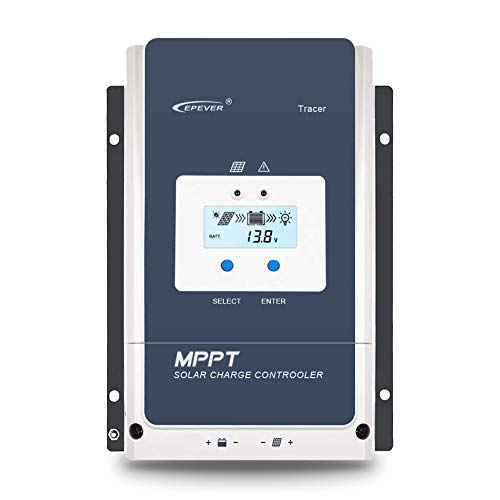
EPEVER Tracer 100A MPPT Controller
Best for: High-capacity solar systems needing 100A charging
- Rated Output Current
- 100A
- Max PV Input Voltage
- 150V
- Battery System Voltage
- 12V/24V/36V/48V DC
- Tracking Technology
- MPPT
- Compatible Battery Types
- Sealed, Gel, Flooded, User
- Dimensions
- 15.5 × 9.52 × 5.62 inches
The EPEVER Tracer AN series delivers 100A of charging current for 12V, 24V, 36V, or 48V battery systems. It features a 150V maximum PV input and MPPT tracking efficiency of 99.5% or higher. The unit supports sealed, gel, flooded, and user-defined battery types. You get automatic voltage identification and RS485 MODBUS connectivity for system expansion. This controller suits users needing high amperage and precise charge management.
- 100A rated output current for high-capacity systems
- 150V maximum PV input voltage
- 99.5% or higher MPPT tracking efficiency
- Supports sealed, gel, flooded, and user battery types
- RS485 MODBUS interface for system expansion
- Heavier build at 18.3 pounds compared to lighter 60A alternatives
- Larger physical dimensions than compact 60A controllers
- No Bluetooth connectivity for mobile monitoring
- You need 100A charging capacity for large battery banks
- You require MODBUS connectivity for system monitoring
- You use sealed, gel, or flooded batteries
- You need Bluetooth connectivity for mobile monitoring
- You require a lighter unit under 10 pounds
- You prefer a compact size smaller than 9.52 inches wide
Verdict: EPEVER Tracer 100A MPPT Controller provides robust 100A charging and MODBUS support for users with large solar arrays. It fits those prioritizing high current and wired system expansion over mobile connectivity.

GCSOAR 100A MPPT Controller with WiFi
Best for: high-power solar systems needing remote app control
- Rated Output Current
- 100A
- Max PV Input Voltage
- 200V
- Battery System Voltage
- 12V, 24V, 48V
- Tracking Technology
- MPPT
- Compatible Battery Types
- Sealed, GEL, Flooded, LiFePO4
- Wireless Connectivity
- WiFi
This GCSOAR unit is a 100A MPPT solar charge controller designed for 12V, 24V, and 48V battery systems. It supports a maximum PV input voltage of 200V and handles up to 5200W for 48V setups. You can monitor and adjust settings remotely using the iConnect app via a WiFi adapter. The device features an LCD display and includes a cooling fan for heat management. It is suitable for various battery types, including LiFePO4.
- 100A rated output current for high-capacity solar arrays
- 200V maximum PV input voltage allows for larger panel strings
- WiFi connectivity enables remote monitoring via the iConnect app
- LCD screen displays real-time system status and error codes
- Supports multiple battery chemistries including LiFePO4 and GEL
- Weighs 8.82 pounds, which is heavier than many competitors
- Requires a separate WiFi adapter for remote app functionality
- Max PV input of 200V is lower than the 300V+ options available from other brands
- You need a high-current 100A controller for a large solar installation
- You prefer remote monitoring and configuration via a smartphone app
- You use a 48V battery system requiring up to 5200W of input power
- You require Bluetooth connectivity without purchasing an additional adapter
- You are looking for a lightweight controller under 5 pounds
- You need a controller with a built-in display that supports 300V input
Verdict: GCSOAR 100A MPPT Solar Charge Controller is a robust option for users who need high current handling and remote app control. It fits well in systems where WiFi monitoring is a priority and the extra weight is manageable.

Renogy Rover 100A MPPT Solar Charge Controller
Best for: High-current off-grid systems requiring automatic detection
- Rated Output Current
- 100A
- Max PV Input Voltage
- 150V
- Battery System Voltage
- 12/24/36/48V
- Tracking Technology
- MPPT
- Compatible Battery Types
- AGM, Gel, Flooded, Lithium, LiFePO4
- Intended Use
- Off-Grid
This Renogy Rover unit is a 100A MPPT solar charge controller designed for off-grid systems. It automatically detects 12V, 24V, 36V, or 48V battery systems and accepts up to 150V PV input. The device supports AGM, Gel, Flooded, and Lithium batteries with adaptive charging stages. You get 99.9% efficiency and rugged IP32 protection. Bluetooth monitoring requires a separate module.
- 100A rated output current for high-capacity systems
- 99.9% MPPT efficiency maximizes energy harvest
- Automatic voltage detection for 12V to 48V systems
- Supports AGM, Gel, Flooded, and Lithium batteries
- Heavier build at 22 pounds compared to lighter alternatives
- Max PV input voltage of 150V is lower than 200V options on the list
- Bluetooth module is sold separately rather than included
- You need a high-current 100A controller for large arrays
- You want automatic voltage detection without manual configuration
- You require rugged IP32 protection for outdoor or RV use
- You need a higher 200V max PV input voltage
- You want a lighter unit under 10 pounds
- You require built-in Bluetooth without buying extra parts
Verdict: Renogy Rover 100A MPPT Solar Charge Controller fits users who need high current capacity and automatic system detection. It suits those prioritizing efficiency and rugged durability over lightweight portability or included wireless modules.
Specifications side by side
| Spec | Ampinvt 120A MPPT Solar Charge Controller | Renogy Rover Lite 60A MPPT | LiTime 60A MPPT Bluetooth Controller | LiTime 48V 60A Bluetooth MPPT | EPEVER Tracer 100A MPPT Controller | GCSOAR 100A MPPT Controller with WiFi | Renogy Rover 100A MPPT Solar Charge Controller |
|---|---|---|---|---|---|---|---|
| Rated Output Current | 120A | 60A | 60A | 60A | 100A | 100A | 100A |
| Max PV Input Voltage | 150V | 150V | 150V | 150V | 150V | 200V | 150V |
| Battery System Voltage | 12V 24V 36V 48V | 12V, 24V, 36V, 48V | 12V-48V | 12V, 24V, 36V, 48V | 12V/24V/36V/48V DC | 12V, 24V, 48V | 12/24/36/48V |
| Tracking Technology | MPPT | MPPT | MPPT | MPPT | MPPT | MPPT | MPPT |
| Compatible Battery Types | Gel, Sealed, Flooded, Lithium | LiFePO4, AGM, Gel, Flooded | LiFePO4, Gel, AGM | LiFePO4, Gel, AGM | Sealed, Gel, Flooded, User | Sealed, GEL, Flooded, LiFePO4 | AGM, Gel, Flooded, Lithium, LiFePO4 |
| Wireless Connectivity | – | – | Bluetooth | Bluetooth | – | WiFi | – |
| Built In Display | LCD | Backlit display | LCD | LCD | – | LCD | – |
| Features | – | – | LiFePO4 Battery | LiFePO4 Battery | – | LiFePO4 Battery, Remote Control | – |
| Intended Use | – | RV, Off-Grid | RV, Off-Grid | Home, RV, Off-Grid | – | – | Off-Grid |
| Voltage | 12V | 12V | 12V | 48V | 12V | 12V | 48V |
| Recommended Use | – | Off-Grid Systems, Boats & Marine | Off-Grid Systems | Off-Grid Systems | – | – | Off-Grid Systems |
| Included Components | Lithium Battery | – | – | – | – | – | – |
| Connectivity | – | – | Bluetooth | Bluetooth | – | Wi-Fi | – |
| Current Rating | – | 60A | 60A | 60A | 100A | 100A | 100A |
| Battery Type | Lithium, Gel | Lithium, AGM, Gel | Lithium, AGM, Gel | Lithium, AGM, Gel | – | Lithium, AGM, Gel | AGM, Gel |
| Technology | MPPT | MPPT | MPPT | MPPT | MPPT | MPPT | MPPT |
| Operation | – | – | – | – | – | – | Manual |
| Dimensions | 11.9 × 5.43 × 17.2 inches | – | 11 × 4.04 × 8.27 inches | 11 × 8.27 × 4.04 inches | 15.5 × 9.52 × 5.62 inches | – | 12 × 17.4 × 4.35 inches |
| Weight | – | – | 10 pounds | 10 pounds | 18.3 pounds | 8.82 pounds | 22 pounds |
| Color | Silver | Black | Black | Black | 100A 150V | 100A 200V (WiFi) | Black |
| Model | AP-120C | MPPT | L48V60A-MPPT-BT-E | 48V60A | Tracer10415AN | – | Rover 100 Amp 12/24/36/48V |
| Size | – | – | 1 Pack | – | 100A | – | 100A MPPT |
Frequently asked questions
What is the highest amperage available in these alternatives?
The EPEVER Tracer 100A and GCSOAR 100A models both offer 100A charging capacity. This is slightly lower than the AMPINVT 120A option. These controllers suit users needing high current for large solar arrays. They provide robust power handling without requiring the highest amperage tier available.
Which controllers support 48V battery systems?
The AMPINVT 120A, LiTime 48V 60A, and Renogy Rover 100A models support 48V systems. These units are designed for higher voltage configurations common in home or large off-grid setups. Other listed controllers like the Renogy Rover Lite 60A are rated for 12V systems only.
Can I monitor my solar system via smartphone?
Yes, the LiTime 60A MPPT Bluetooth Controller and LiTime 48V 60A Bluetooth MPPT allow remote monitoring via Bluetooth. The GCSOAR 100A MPPT Controller with WiFi provides app control through a wireless connection. These options are ideal if you need real-time data access from your phone.
What is the maximum PV input voltage for these models?
Most listed controllers, including the AMPINVT 120A, Renogy Rover Lite 60A, and EPEVER Tracer 100A, support a maximum PV input voltage of 150V. The GCSOAR 100A model supports up to 200V. This spec determines how many panels you can connect in series safely.
Which controller is best for RV use?
The Renogy Rover Lite 60A MPPT and LiTime 60A MPPT Bluetooth Controller are recommended for RVs. They offer 60A capacity, which fits typical mobile power needs. Their compact size and automatic voltage detection make them practical for smaller, mobile off-grid systems compared to larger home units.
Do any models include remote control features?
The GCSOAR 100A MPPT Controller with WiFi includes remote control capabilities via an app. This allows you to adjust settings or monitor status from a distance. The LiTime Bluetooth models also offer remote monitoring, though they use Bluetooth rather than WiFi for connectivity.


