
As Amazon Associates, we earn from qualifying purchases. This means we may receive a small commission at no extra cost to you if you click through and make a purchase.
As an Amazon Associate we earn from qualifying purchases. Links on this page are affiliate links.
When you compare a 120V vs 120v240v power inverter, you are choosing between simple 12V setups and complex 48V systems. Both units deliver pure sine wave power for sensitive electronics. The main difference lies in voltage and scale. The BELTTT offers 3000W continuous power for RVs. The VEVOR provides 6400W split-phase output for heavy off-grid homes. Your choice depends on your battery bank and power needs.
Continuous Wattage
3000W
6400W
AC Output Voltage
120V
120V/240V Split Phase
DC Input Voltage
12V
48V
Weight
9.92 pounds
78.5 pounds
Remote Control
23 ft wired remote
not listed
Connectivity
not listed
Wi-Fi
Choose the first if
- You need a lightweight inverter for an RV or truck.
- You have a 12V battery bank and simple 120V loads.
- You want a wired remote for easy troubleshooting.
Choose the second if
- You require 240V output for heavy-duty appliances.
- You have a 48V battery system for off-grid living.
- You need Wi-Fi connectivity to monitor your system.
Verdict
Choose the BELTTT if you need a portable, lightweight solution for vehicles or small cabins. Select the VEVOR if you are building a permanent off-grid home that requires higher power and 240V capability. The decision rests entirely on your battery voltage and appliance requirements.
120V vs 120V/240V Inverter Comparison
Output Voltage
Edge: VEVOR 6400W 48V Hybrid Solar Inverter
The VEVOR inverter supports 120V and 240V split-phase output, making it suitable for heavy-duty appliances that require higher voltage, such as large air conditioners or electric dryers. This dual-voltage capability allows you to power more demanding equipment in off-grid homes. The BELTTT inverter is limited to 120V AC output. This standard voltage is sufficient for most household electronics, tools, and RV appliances. If you only need to power standard 120V devices, the BELTTT covers your needs. However, if your setup requires 240V circuits, the VEVOR is the only viable option.
Continuous Wattage
Edge: VEVOR 6400W 48V Hybrid Solar Inverter
Power capacity is a major differentiator between these two units. The VEVOR provides 6400W of continuous wattage, which is more than double the capacity of the BELTTT. This high output allows the VEVOR to run multiple large appliances simultaneously without overloading. The BELTTT offers 3000W of continuous power, with a peak surge of 6000W for starting motors. This is adequate for running a refrigerator, TV, and lights together. For light to moderate loads, the BELTTT is sufficient. For whole-home or heavy industrial use, the VEVOR delivers significantly more power.
Battery Compatibility
Edge: BELTTT 3000W Pure Sine Wave Inverter
These inverters require different battery systems. The BELTTT operates on a 12V DC input, which is the standard for most vehicles, boats, and small RVs. You can connect it directly to a standard 12V battery bank. The VEVOR requires a 48V DC input. This higher voltage system is typical for larger residential solar setups and dedicated off-grid home batteries. You cannot use the VEVOR with a standard 12V car battery. If you are working with a vehicle or a small 12V setup, the BELTTT is the correct choice. For a dedicated 48V battery bank, the VEVOR is required.
Conversion Efficiency
Edge: VEVOR 6400W 48V Hybrid Solar Inverter
Efficiency determines how much battery power is wasted as heat. The VEVOR boasts a 99% conversion efficiency, aided by its built-in MPPT solar charge controller. This means almost all energy from your solar panels or batteries reaches your appliances. The BELTTT states a conversion efficiency of greater than 93%. While this is good, it is lower than the VEVOR. The difference matters most when you have limited battery capacity or solar input. Higher efficiency extends your runtime. The VEVOR is more efficient, but you must consider the additional complexity of its hybrid design.
Portability and Weight
Edge: BELTTT 3000W Pure Sine Wave Inverter
Size and weight affect where you can place the inverter. The BELTTT weighs 9.92 pounds and measures 17 inches in length. It is compact enough to mount in an RV cabinet or under a seat. The VEVOR weighs 78.5 pounds and stands 21.5 inches tall. It is a large, stationary unit designed for installation in a utility room or garage. You cannot easily move the VEVOR. If you need a portable solution for travel or temporary use, the BELTTT is far more practical. The VEVOR is a fixed installation piece.
Which inverter fits your power needs
RV owners needing simple 12V power
Our pick: BELTTT 3000W Pure Sine Wave Inverter
The BELTTT unit runs on a standard 12V DC input, making it ideal for vehicles with basic battery systems. It delivers 3000W continuous power with a 6000W surge. The compact size and included 23 ft wired remote allow for easy installation in tight spaces without complex wiring changes.
Off-grid users with 48V battery banks
Our pick: VEVOR 6400W 48V Hybrid Solar Inverter
The VEVOR inverter requires a 48V DC input, which is standard for larger stationary off-grid systems. It provides 6400W continuous power and includes a built-in 120A MPPT solar charge controller. This integration reduces component count and maximizes energy yield from solar panels for heavy-duty daily use.
Homeowners powering 240V appliances
Our pick: VEVOR 6400W 48V Hybrid Solar Inverter
You need split-phase output for high-voltage equipment like electric dryers or large air conditioners. The VEVOR inverter supports 120V/240V split-phase output, allowing you to run heavy loads that a standard 120V inverter cannot handle. Its pure sine wave ensures safe operation for sensitive electronics alongside these appliances.
| # | Product | Best for | Price |
|---|---|---|---|
| 1 | BELTTT 3000W Pure Sine Wave Inverter | RV and truck off-grid 120V power needs | |
| 2 | VEVOR 6400W 48V Hybrid Solar Inverter | off-grid homes with 48V batteries |

BELTTT 3000W Pure Sine Wave Inverter
Best for: RV and truck off-grid 120V power needs
- Voltage
- 120V
- Continuous Wattage
- 3000W
- Surge Wattage
- 6000W
- Waveform
- Pure Sine Wave
- DC Input Voltage
- 12V
- AC Output Voltage
- 110V 120V
This BELTTT inverter converts 12V DC battery power to 120V AC output. It provides 3000W of continuous power and 6000W of peak surge capacity. The unit features a pure sine wave output, which protects sensitive electronics from damage. An LCD display shows real-time voltage and load status. A 23 ft wired remote allows for convenient operation. It is designed for off-grid, RV, and truck applications where reliable 120V power is needed.
- 3000W continuous and 6000W peak surge output
- Pure sine wave output for sensitive electronics
- 23 ft wired remote control included
- LCD display shows input/output voltage and status
- Multiple safety protections against overload and short circuit
- Limited to 12V DC input, requiring a larger battery bank
- Heavier at 9.92 pounds compared to smaller inverters
- Only provides 120V output, not 240V
- You need a 12V inverter for an RV or truck
- You want to power sensitive electronics with pure sine wave
- You prefer a wired remote for easy access
- You require 240V output for heavy appliances
- You have a 24V or 48V battery system
- You need a compact unit under 5 pounds
Verdict: BELTTT 3000W 12V Pure Sine Wave Inverter is a solid choice for RV and truck owners who need reliable 120V power from a 12V battery. It suits users who value clear status monitoring and remote control access.
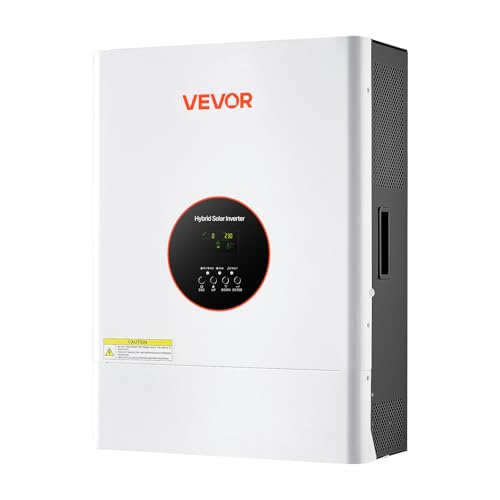
VEVOR 6400W 48V Hybrid Solar Inverter
Best for: off-grid homes with 48V batteries
- Voltage
- 120V/240V
- Continuous Wattage
- 6400W
- Waveform
- Pure Sine Wave
- DC Input Voltage
- 48V
- AC Output Voltage
- 120V/240V Split Phase
- Intended Use
- Off-Grid
This VEVOR unit combines a 6400W continuous inverter with a 120A MPPT solar charge controller. It supports 48V battery systems and delivers 120V/240V split-phase output. The pure sine wave ensures stable power for sensitive electronics. You get 99% conversion efficiency and Wi-Fi connectivity for monitoring. It is built for off-grid setups requiring heavy-duty equipment and solar integration.
- 6400W continuous output for heavy loads
- Built-in 120A MPPT solar charge controller
- 120V/240V split-phase AC output
- Pure sine wave for sensitive electronics
- Wi-Fi connectivity for system monitoring
- 78.5-pound weight requires sturdy mounting
- 48V battery requirement limits compatibility
- Large dimensions at 21.5 inches tall
- You need 120V/240V split-phase power
- You have a 48V battery bank
- You want integrated solar charging
- You only need 120V output
- You use a 12V or 24V system
- You have limited installation space
Verdict: VEVOR 6400W 48V Hybrid Inverter suits off-grid users needing split-phase power and solar control. It fits systems with 48V batteries and ample mounting space.
Specifications side by side
| Spec | BELTTT 3000W Pure Sine Wave Inverter | VEVOR 6400W 48V Hybrid Solar Inverter |
|---|---|---|
| Continuous Wattage | 3000W | 6400W |
| Surge Wattage | 6000W | – |
| Waveform | Pure Sine Wave | Pure Sine Wave |
| DC Input Voltage | 12V | 48V |
| AC Output Voltage | 110V 120V | 120V/240V Split Phase |
| AC Outlets | Dual AC socket, 20A outlet | – |
| Remote Control | 23 ft wired remote | – |
| Features | USB Ports, Remote Control, Pure Sine Wave, LCD Display | Pure Sine Wave |
| Intended Use | RV, Off-Grid | Off-Grid |
| Voltage | 120V | 120V/240V |
| Wattage | 3000W | – |
| Recommended Use | Off-Grid Systems | Off-Grid Systems |
| Included Components | Inverter | Inverter, Lithium Battery |
| Power Plug | Hardwired | – |
| Connectivity | – | Wi-Fi |
| Application | Truck | – |
| Battery Type | – | Lithium |
| Technology | – | MPPT |
| Dimensions | 17 × 7.7 × 3.9 inches | 15.8 × 7.09 × 21.5 inches |
| Weight | 9.92 pounds | 78.5 pounds |
| Size | 3000W | 48V to 120V/240V 6400W |
| Color | Black | white |
| Model | BAP3000A | VS8048AMN |
Frequently asked questions
Can a 120V inverter power 240V appliances?
No. A 120V inverter only provides single-phase power. You cannot plug standard 240V appliances into it. Devices like large air conditioners or electric dryers require split-phase 120V/240V output. Using a 120V unit for these tools will fail or damage the equipment.
What is the main difference between 120V and 120V/240V inverters?
The difference is output voltage and system complexity. A 120V inverter works with simple 12V battery banks. A 120V/240V inverter uses 48V batteries to create split-phase power. This allows you to run heavy-duty home appliances that need higher voltage for proper operation.
Do I need a 120V/240V inverter for my RV?
Usually, you do not. Most RV appliances run on 120V single-phase power. A 120V inverter like the BELTTT 3000W model suits these needs. It connects to a 12V battery and powers standard RV electronics without the bulk and cost of a complex 48V split-phase system.
Can I use a 120V inverter for off-grid home power?
You can, but it limits your appliance choices. A 120V inverter works for lights, TVs, and small kitchen tools. It cannot power large 240V loads like dryers or central AC. For full home backup, a 120V/240V inverter with 48V battery support offers more versatility.
How does battery voltage affect inverter choice?
Battery voltage determines the inverter type. 12V batteries pair with 120V inverters for vehicles. 48V batteries pair with 120V/240V inverters for homes. Higher battery voltage reduces current flow, allowing thinner wires for high-wattage systems. The VEVOR 6400W unit requires a 48V battery bank.
Is pure sine wave important for both inverter types?
Yes. Both inverters should output pure sine wave power. This clean electricity protects sensitive electronics like laptops and medical devices. The BELTTT and VEVOR units both provide pure sine wave output. This ensures your gadgets run safely and efficiently regardless of the voltage configuration.


