
As Amazon Associates, we earn from qualifying purchases. This means we may receive a small commission at no extra cost to you if you click through and make a purchase.
As an Amazon Associate we earn from qualifying purchases. Links on this page are affiliate links.
This solar charge controller buying guide helps you match specs to your system needs. You will decide between MPPT technology and PWM, check voltage ratings, and verify current capacity for your battery bank. The list covers eight models chosen strictly from their published specifications. Each product was selected based on data points like maximum PV input voltage, amperage limits, and connectivity options such as Bluetooth.
You will learn how to interpret these numbers in practice. High amperage supports larger solar arrays, while higher voltage ratings allow for more panels in series. The guide walks you through these decisions so you can pick a unit that fits your off-grid or RV setup. You will see how size, weight, and battery type compatibility affect your choice. Focus on the specs that matter for your specific power requirements.
Key Specs for Solar Controllers
Current rating capacity
The current rating determines how much electricity the controller can send to your batteries. You must match this number to your solar array’s output. If the rating is too low, the controller limits power and wastes potential energy. For large off-grid systems, look for high amperage options like the Renogy Rover 100A. Smaller RV setups may only need 50A. Always calculate your total panel wattage and divide by system voltage to find the required amps. Choose a model with headroom above your peak output to prevent overheating during sunny days. This ensures consistent charging without bottling your system’s performance.
Look for
- Check max amperage rating
- Match to panel output
- Add 20% safety margin
MPPT technology type
MPPT stands for Maximum Power Point Tracking. This technology actively adjusts voltage to pull the most power from your panels. It is significantly more efficient than older PWM controllers, especially in cold or cloudy weather. Nearly all modern picks use MPPT. The Victron SmartSolar models and LiTime units all feature this advanced tracking. You get more charge per watt of sunlight compared to basic controllers. This efficiency gain pays for the higher upfront cost over time. If you want maximum energy harvest, stick with MPPT. Avoid PWM unless you have a very small, budget-focused setup where efficiency matters less.
Look for
- Ensure MPPT technology
- Avoid outdated PWM
- Check efficiency claims
System voltage support
Your controller must match the voltage of your battery bank. Most units support 12V, 24V, or 48V systems. Some models auto-detect the voltage, while others require manual setting. The Renogy Rover 100A supports 12/24/36/48V automatically. The Victron 250V 85A is designed for 48V systems. Using the wrong voltage can damage your batteries or the controller. Verify the compatible voltage range before buying. Higher voltage systems like 48V allow for thinner wires and less loss over distance. Ensure the controller handles your specific battery voltage configuration to avoid compatibility issues.
Look for
- Match battery voltage
- Check auto-detect feature
- Verify voltage range
Max PV input voltage
This spec sets the limit for how much voltage your solar panels can send to the controller. It depends on how you wire your panels. Series wiring increases voltage; parallel wiring increases current. The Victron 250V 85A handles up to 250V, allowing more panels in series. The Renogy Rover 100A handles 150V. You must calculate the open-circuit voltage of your panels in the coldest expected temperature. If this exceeds the controller limit, you will destroy the unit. Always leave a safety buffer. Check this spec carefully if you plan to expand your solar array later.
Look for
- Check max input voltage
- Calculate panel VOC
- Consider cold weather buffer
Battery type compatibility
Different batteries require different charging profiles. Lead-acid batteries like AGM and Gel need specific voltage settings. Lithium batteries, especially LiFePO4, require precise charging curves. The LiTime controller explicitly supports LiFePO4 batteries. The Temank model also lists lithium compatibility. Using a controller that does not support your battery type can reduce lifespan or cause safety issues. Ensure the controller offers programmable settings for your specific chemistry. If you use multiple battery types, verify the controller can switch between them or is set for your primary bank. This ensures safe and efficient charging cycles.
Look for
- Verify battery chemistry support
- Check LiFePO4 compatibility
- Review charging profiles
Connectivity and monitoring
Modern controllers often include Bluetooth for remote monitoring. The Victron SmartSolar series and LiTime unit both offer Bluetooth connectivity. This lets you check status via a smartphone app. You can track charging current, voltage, and battery health without opening your equipment cabinet. The Outback FM80 lacks smart features, focusing on raw robustness instead. Decide if remote data is essential for your setup. Bluetooth adds convenience for troubleshooting and optimization. If you need real-time data, prioritize models with built-in wireless capabilities. This feature simplifies maintenance for off-grid or RV users.
Look for
- Check for Bluetooth
- Verify app compatibility
- Assess remote needs
Intended use and form
Controllers vary by application. Some are built for RVs, like the Renogy 50A DC-DC model. This unit handles alternator charging alongside solar. Others are for fixed home off-grid systems. The size and weight matter for installation. The Victron 250V 85A is compact at 7.87 inches wide. The Renogy Rover 100A is larger and heavier. Consider your mounting space and environmental conditions. RV users need compact, rugged units. Home users might prioritize higher capacity over size. Match the controller’s physical footprint and durability to your specific installation environment to ensure a secure fit.
Look for
- Match use case
- Check physical dimensions
- Verify mounting options
Solar Charge Controller Types
High-Capacity MPPT Controllers
These units handle large solar arrays with current ratings of 80A to 140A. The Renogy Rover 100A and Temank 140A models support 48V systems and offer substantial power handling. They suit off-grid homes or large RVs with extensive panel setups. The main trade-off is size and weight. These controllers are bulkier and heavier than smaller units. You need adequate mounting space and strong structural support for installation. They deliver high output but require careful wiring management to handle the current safely.
Smart MPPT Controllers
Smart controllers add Bluetooth connectivity for remote monitoring and configuration via a mobile app. Victron SmartSolar and LiTime models offer this feature alongside MPPT efficiency. You can track battery status and adjust settings without physical access to the unit. This is ideal for hard-to-reach installations or systems requiring frequent adjustments. The trade-off involves relying on a smartphone or tablet for management. You lose direct physical feedback from the device itself. These models are versatile but depend on your mobile device for full functionality and real-time data access.
Compact DC-DC Controllers
DC-DC controllers like the Renogy 50A unit are designed for specific vehicle applications. They integrate solar charging with alternator input for 12V RV systems. This all-in-one approach simplifies wiring for mobile setups. The unit is small and lightweight, fitting easily in confined spaces. It suits travelers who need quiet, efficient charging while driving and parked. The trade-off is limited voltage range. These controllers generally do not support high-voltage solar arrays or large 48V battery banks. They are specialized tools for mobile power management rather than stationary home systems.
Mistakes to Avoid When Buying
Ignoring voltage limits for your battery bank
Connect a controller with a low input voltage to a high-voltage panel array. The unit will fail or shut down. Check the maximum input voltage rating in the specifications. Ensure it exceeds your panels' open-circuit voltage under cold conditions to prevent damage.
Matching current rating to panels instead of batteries
Size the controller based on your solar array's output, not just the battery size. If the amp rating is too low, the controller clips power. Verify the continuous current rating handles your total panel amperage. This ensures you capture all available energy.
Assuming all controllers work with any battery type
Lead-acid and lithium batteries require different charging profiles. Verify the controller supports your specific battery chemistry. Lithium batteries often need precise voltage cutoffs. Using the wrong profile can reduce battery life or cause safety issues. Check the supported battery types in the specs.
Overlooking environmental protection ratings for outdoor use
Place a controller with low ingress protection outdoors. Moisture and dust can cause short circuits or corrosion. Look for IP ratings in the specifications. An IP65 rating offers good protection for outdoor installations. Ensure the enclosure matches your mounting environment to avoid premature failure.
| # | Product | Best for | Price |
|---|---|---|---|
| 1 | Renogy Rover 100A MPPT Solar Charge Controller | Large off-grid systems requiring 100A capacity | |
| 2 | Victron SmartSolar MPPT 100A 150V | high-current 48V solar systems with Bluetooth needs | |
| 3 | Temank 140A 48V MPPT Solar Controller | Large 48V solar arrays needing high current | |
| 4 | Victron Energy SmartSolar 250V 85A MPPT | High voltage solar arrays with app monitoring needs | |
| 5 | LiTime 48V 60A Bluetooth MPPT | off-grid systems needing Bluetooth monitoring | |
| 6 | Renogy 50A 12V DC-DC Solar Controller | RV 12V systems needing solar and alternator charging | |
| 7 | Outback FM80 80A MPPT Controller | Robust 48V MPPT charging without smart features | |
| 8 | Victron SmartSolar MPPT 150V 100A Bluetooth | 100A MPPT systems with Bluetooth monitoring |

Renogy Rover 100A MPPT Solar Charge Controller
Best for: Large off-grid systems requiring 100A capacity
- Rated Output Current
- 100A
- Max PV Input Voltage
- 150V
- Battery System Voltage
- 12/24/36/48V
- Tracking Technology
- MPPT
- Compatible Battery Types
- AGM, Gel, Flooded, Lithium, LiFePO4
- Intended Use
- Off-Grid
This Renogy Rover unit is a 100A MPPT solar charge controller designed for off-grid systems. It supports 12V, 24V, 36V, and 48V battery systems with a maximum PV input of 150V. The device offers 99.9% efficiency and includes protection against reverse polarity and short circuits. You get automatic voltage detection and compatibility with AGM, Gel, Flooded, and Lithium batteries. It weighs 22 pounds and features a rugged housing for reliable performance.
- 100A rated output current for high-capacity systems
- 99.9% MPPT efficiency for maximum energy harvest
- Supports 12V, 24V, 36V, and 48V battery voltages
- Automatic system voltage detection without manual configuration
- Compatible with AGM, Gel, Flooded, and LiFePO4 batteries
- Weighs 22 pounds, which is heavier than lighter alternatives
- Max PV input is 150V, lower than the 250V option available on other list items
- Bluetooth module is sold separately for wireless monitoring
- You need a 100A controller for a large off-grid array
- You use a 48V battery system with high current demands
- You want automatic voltage detection for AGM or Lithium batteries
- You require a 48V controller with higher than 100A capacity
- You need a unit with a 250V max PV input
- You want integrated Bluetooth without purchasing an extra module
Verdict: Renogy Rover 100A MPPT Solar Controller suits users needing high current capacity and automatic voltage detection for robust off-grid setups. It is a solid choice for 48V systems requiring 100A output.
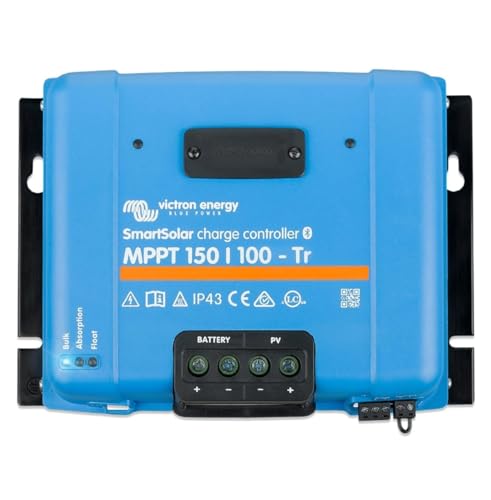
Victron SmartSolar MPPT 100A 150V
Best for: high-current 48V solar systems with Bluetooth needs
- Rated Output Current
- 100A
- Max PV Input Voltage
- 150V
- Battery System Voltage
- 12/24/36/48V
- Tracking Technology
- MPPT
- Wireless Connectivity
- Bluetooth
- Dimensions
- 11.4 × 13 × 6.3 inches
This Victron Energy controller uses MPPT technology to maximize power output from solar panels. It supports 12, 24, 36, and 48V battery systems with a 100A rated output current. The unit features Bluetooth connectivity for remote monitoring via the VictronConnect app. Its 150V max PV input voltage allows for flexible panel configurations. You get synchronized charging capabilities for multiple units. This model suits users needing reliable, high-current solar regulation.
- 100A rated output current for high power loads
- MPPT tracking technology optimizes energy harvest
- Bluetooth connectivity for remote configuration and monitoring
- Supports 12/24/36/48V battery system voltages
- 150V max PV input voltage capability
- 150V max PV input is lower than the 250V options available from competitors
- 100A current rating is lower than the 140A and higher amp models on the list
- 11.1 pound weight is heavier than smaller capacity controllers
- You need a 100A solar charge controller for a large array
- You want to monitor and configure settings via Bluetooth
- You require synchronization between multiple charge controllers
- You need a higher 140A or 150A current capacity
- You require a 250V max PV input voltage
- You prefer a lighter unit under 10 pounds
Verdict: Victron Energy SmartSolar MPPT 100A delivers robust 100A regulation and Bluetooth control for complex solar setups. It fits users who prioritize synchronized charging and remote monitoring over maximum voltage headroom.

Temank 140A 48V MPPT Solar Controller
Best for: Large 48V solar arrays needing high current
- Rated Output Current
- 140A
- Max PV Input Voltage
- 500V
- Battery System Voltage
- 48V
- Tracking Technology
- MPPT
- Compatible Battery Types
- Lead-Acid, LiFePO4, Gel, Flooded
- Built In Display
- LCD
This Temank unit is a 48V MPPT solar charge controller rated for 140A. It accepts up to 500V PV input and supports 6500W of power. The large LCD screen displays real-time system data. It works with lead-acid, gel, flooded, and lithium batteries. You get customizable charging parameters and dual fans for heat dissipation. It suits users needing high current and voltage flexibility for large battery banks.
- 140A rated output current for high-capacity systems
- 500V max PV input voltage for series panel arrays
- Large LCD screen shows detailed real-time metrics
- Supports lead-acid, gel, flooded, and lithium batteries
- Dual smart fans for effective heat dissipation
- 140A output is lower than the 150A and 100A options on other products
- Max PV input current limited to 18A
- Orange color may not match standard black equipment
- You need a 48V system with high current handling
- You want to connect solar panels in series for higher voltage
- You prefer a large LCD for detailed monitoring
- You require a 12V or 24V battery system
- You need an output current higher than 140A
- You prefer black equipment to match other components
Verdict: Temank 48V 140A MPPT Controller fits users building large 48V solar arrays who need high current capacity and detailed LCD monitoring. It is a solid choice for those willing to use series-connected panels to maximize input voltage.

Victron Energy SmartSolar 250V 85A MPPT
Best for: High voltage solar arrays with app monitoring needs
- Rated Output Current
- 85A
- Max PV Input Voltage
- 250V
- Battery System Voltage
- 12/24/36/48V
- Tracking Technology
- MPPT
- Wireless Connectivity
- Bluetooth
- Dimensions
- 4.33 × 7.87 × 1.97 inches
The Victron Energy SmartSolar MPPT Tr VE.Can 250V 85A is a solar charge controller designed for 12, 24, 36, and 48V battery systems. It features a 250V max PV input and 85A rated output. Bluetooth connectivity allows you to monitor performance via the VictronConnect app. This unit supports synchronized charging for multiple controllers and includes an intelligent load output for direct device power.
- 85A rated output current
- 250V max PV input voltage
- Bluetooth connectivity for real-time monitoring
- Supports 12/24/36/48V battery systems
- Synchronized charging for multiple units
- 85A rated output is lower than the 100A options on this list
- 12.3 pounds weight is heavier than lighter 60A or 70A models
- 7.87 inches width is bulkier than compact 150V variants
- You need a high 250V input for large solar arrays
- You want Bluetooth monitoring via the VictronConnect app
- You require synchronized charging across multiple controllers
- You need the maximum 100A output available
- You prefer a lighter unit under 10 pounds
- You require a more compact footprint under 6 inches wide
Verdict: Victron SmartSolar MPPT 250V 85A suits users who prioritize high voltage input and app-based monitoring over the absolute highest amperage or smallest size. It fits systems needing synchronized multi-controller setups.

LiTime 48V 60A Bluetooth MPPT
Best for: off-grid systems needing Bluetooth monitoring
- Rated Output Current
- 60A
- Max PV Input Voltage
- 150V
- Battery System Voltage
- 12V, 24V, 36V, 48V
- Tracking Technology
- MPPT
- Compatible Battery Types
- LiFePO4, Gel, AGM
- Wireless Connectivity
- Bluetooth
The LiTime 48V 60A MPPT controller handles 12V, 24V, 36V, and 48V battery systems with a 150V max PV input. It features 99% tracking efficiency and an LCD screen for real-time status. Built-in Bluetooth lets you monitor the system from up to 50 feet away. This unit weighs 10 pounds and measures 11 inches in length. It suits off-grid home or RV setups using LiFePO4, Gel, or AGM batteries.
- 99% MPPT tracking efficiency for faster charging
- Built-in Bluetooth for remote monitoring up to 50 feet
- LCD screen displays real-time charging and load status
- Die-cast aluminum heat sink for stable fan-less operation
- 60A rated output is lower than the 85A and 100A options on this list
- 10-pound weight is heavier than many compact controllers
- Not waterproof, limiting use in marine environments
- You need Bluetooth monitoring without external wiring
- You use a 48V LiFePO4 or AGM battery bank
- You want an LCD screen for local status checks
- You require a waterproof unit for marine use
- You need more than 60A of continuous output
- You prefer a controller without wireless connectivity
Verdict: LiTime 48V 60A MPPT Controller offers solid 99% efficiency and convenient Bluetooth monitoring for off-grid systems. It fits users who prioritize remote tracking and LCD visibility over maximum amperage or weatherproofing.
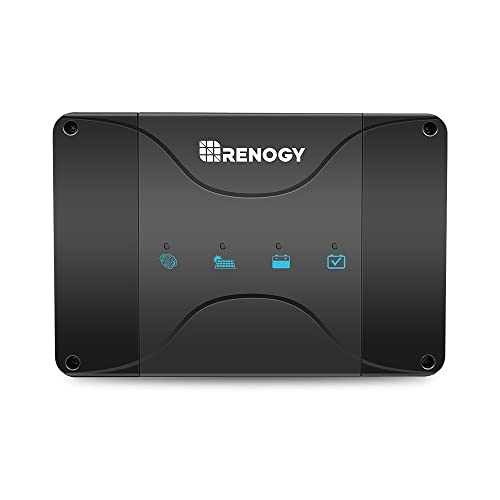
Renogy 50A 12V DC-DC Solar Controller
Best for: RV 12V systems needing solar and alternator charging
- Rated Output Current
- 50A
- Max PV Input Voltage
- 50V
- Battery System Voltage
- 12V
- Tracking Technology
- MPPT
- Compatible Battery Types
- AGM, Gel, Flooded, Li
- Intended Use
- RV
This Renogy unit combines a 50A MPPT solar controller with a DC-to-DC charger for RVs. It handles 12V battery systems with a max PV input of 50V. The device supports AGM, Gel, and flooded batteries. It includes a remote temperature sensor port for accurate compensation. You get real-time monitoring via a Bluetooth module and app. The fanless design ensures silent operation while charging.
- 99% tracking efficiency for solar input
- 50A rated output current
- DC-to-DC charging from alternator
- Fanless heat dissipation for silent use
- Supports AGM, Gel, and flooded batteries
- 12V battery system limits use to single-voltage setups
- 50V max PV input is lower than 150V or 250V controllers
- 50A output is lower than 85A or 100A options
- You need a combined solar and alternator charger for an RV
- You run a 12V battery system
- You want silent operation without a cooling fan
- You require a 24V, 36V, or 48V system
- You need to connect high-voltage solar arrays over 50V
- You need more than 50A of charging current
Verdict: Renogy 50A 12V DC-DC Solar Charger suits RV owners who need a quiet, all-in-one solution for 12V systems. It fits users who value high solar efficiency and alternator integration over high voltage capacity.

Outback FM80 80A MPPT Controller
Best for: Robust 48V MPPT charging without smart features
- Tracking Technology
- MPPT
- Included Components
- MPPT Charge Controller
- Dimensions
- 16.3 × 5.75 × 4.5 inches
- Weight
- 14 pounds
The Outback Power FM80 is an MPPT solar charge controller designed for robust performance. It features a tracking technology of MPPT to optimize energy harvest. The unit measures 16.3 inches in length, 5.75 inches in width, and 4.5 inches in height. Weighing 14 pounds, it offers a solid build for your solar array. This controller suits users who need a reliable, dedicated MPPT solution without smart connectivity features.
- MPPT tracking technology for efficient power conversion
- Compact dimensions of 5.75 x 4.5 x 16.3 inches
- Durable 14-pound build for stable mounting
- Includes the MPPT charge controller unit
- 80A capacity is lower than the 100A and 140A options on this list
- Heavier at 14 pounds compared to lighter alternatives
- Larger physical footprint than more compact controllers
- You need a dedicated MPPT controller for a 48V system
- You prefer a sturdy, heavy-duty unit for permanent installation
- You want a simple, reliable controller without smart features
- You require more than 80A of continuous charging current
- You need Bluetooth connectivity for remote monitoring
- You are looking for a lightweight, portable solution
Verdict: Outback FM80 MPPT Controller is a solid choice for users who prioritize capacity and build quality over smart features. It fits best in systems where 80A is sufficient and a robust, non-smart controller is preferred.

Victron SmartSolar MPPT 150V 100A Bluetooth
Best for: 100A MPPT systems with Bluetooth monitoring
- Rated Output Current
- 100A
- Max PV Input Voltage
- 150V
- Battery System Voltage
- 12/24/36/48V
- Tracking Technology
- MPPT
- Wireless Connectivity
- Bluetooth
- Dimensions
- 10.6 × 9.84 × 5.91 inches
This Victron Energy controller uses MPPT technology to maximize solar output. It supports 12, 24, 36, and 48V battery systems with a 100A rated output current. The 150V max PV input voltage allows for flexible panel configurations. Bluetooth connectivity lets you monitor real-time data via the VictronConnect app. It is suitable for users needing synchronized charging and intelligent load management.
- 100A rated output current for high power handling
- Supports 12/24/36/48V battery systems
- 150V max PV input voltage
- Bluetooth connectivity for app monitoring
- Synchronized charging for multiple units
- Lower max PV input voltage of 150V compared to 250V options
- 100A current rating is lower than 140A alternatives
- Physical dimensions of 10.6 x 9.84 x 5.91 inches are bulkier
- You need 100A capacity for your solar array
- You require Bluetooth monitoring via the VictronConnect app
- You are using a 12, 24, 36, or 48V battery system
- You need a higher 140A current rating
- You require a 250V max PV input voltage
- You prefer a more compact physical footprint
Verdict: Victron Energy SmartSolar MPPT 100A fits users who need robust 100A output and app-based monitoring. It is ideal for systems where 150V input is sufficient and Bluetooth connectivity is a priority.
Specifications side by side
| Spec | Renogy Rover 100A MPPT Solar Charge Controller | Victron SmartSolar MPPT 100A 150V | Temank 140A 48V MPPT Solar Controller | Victron Energy SmartSolar 250V 85A MPPT | LiTime 48V 60A Bluetooth MPPT | Renogy 50A 12V DC-DC Solar Controller | Outback FM80 80A MPPT Controller | Victron SmartSolar MPPT 150V 100A Bluetooth |
|---|---|---|---|---|---|---|---|---|
| Rated Output Current | 100A | 100A | 140A | 85A | 60A | 50A | – | 100A |
| Max PV Input Voltage | 150V | 150V | 500V | 250V | 150V | 50V | – | 150V |
| Battery System Voltage | 12/24/36/48V | 12/24/36/48V | 48V | 12/24/36/48V | 12V, 24V, 36V, 48V | 12V | – | 12/24/36/48V |
| Tracking Technology | MPPT | MPPT | MPPT | MPPT | MPPT | MPPT | MPPT | MPPT |
| Compatible Battery Types | AGM, Gel, Flooded, Lithium, LiFePO4 | – | Lead-Acid, LiFePO4, Gel, Flooded | – | LiFePO4, Gel, AGM | AGM, Gel, Flooded, Li | – | – |
| Wireless Connectivity | – | Bluetooth | – | Bluetooth | Bluetooth | – | – | Bluetooth |
| Built In Display | – | – | LCD | – | LCD | – | – | – |
| Features | – | – | – | – | LiFePO4 Battery | – | – | – |
| Intended Use | Off-Grid | – | – | – | Home, RV, Off-Grid | RV | – | – |
| Voltage | 48V | 48V | 48V | 48V | 48V | – | – | 48V |
| Recommended Use | Off-Grid Systems | – | – | – | Off-Grid Systems | – | – | – |
| Included Components | – | – | Lithium Battery | – | – | – | MPPT Charge Controller | – |
| Amperage | – | – | – | – | – | 50A | – | – |
| Connectivity | – | Bluetooth | – | Bluetooth | Bluetooth | – | – | Bluetooth |
| Current Rating | 100A | 100A | – | – | 60A | – | – | 100A |
| Battery Type | AGM, Gel | – | Lithium | – | Lithium, AGM, Gel | AGM, Gel | – | – |
| Technology | MPPT | MPPT | MPPT | MPPT | MPPT | MPPT | MPPT | MPPT |
| Operation | Manual | – | – | – | – | – | – | – |
| Dimensions | 12 × 17.4 × 4.35 inches | 11.4 × 13 × 6.3 inches | – | 4.33 × 7.87 × 1.97 inches | 11 × 8.27 × 4.04 inches | 9.62 × 5.81 × 3.02 inches | 16.3 × 5.75 × 4.5 inches | 10.6 × 9.84 × 5.91 inches |
| Weight | 22 pounds | 11.1 pounds | – | 12.3 pounds | 10 pounds | 4.75 pounds | 14 pounds | – |
| Size | 100A MPPT | – | – | – | – | 50A MPPT-Alternator Input | – | – |
| Color | Black | Blue | Orange | Blue | Black | Black | BLACK | Blue |
| Model | Rover 100 Amp 12/24/36/48V | SCC115110211 | US-POW-48140A-YF | SCC125085411 | 48V60A | RBC50D1S-G2 | FM80 | SCC115110410 |
Frequently asked questions
Can I use a 12V controller on a 48V battery system?
No. You must match the controller voltage to your battery bank. The Victron SmartSolar MPPT 100A and Renogy Rover 100A are designed for 48V systems. Using a lower voltage unit can damage the equipment. Always check the specified voltage rating in the product attributes before purchasing.
What is the difference between MPPT and PWM technology?
MPPT technology maximizes energy harvest by adjusting voltage and current. All listed models, including the Outback FM80 and LiTime 60A, use MPPT. This method is more efficient than PWM, especially in varying light conditions. It ensures your solar array operates at its peak power point.
Do I need Bluetooth connectivity for my solar controller?
Bluetooth is optional but useful for remote monitoring. The Victron SmartSolar models and LiTime 60A include this feature. It allows you to track performance via an app. If you prefer simplicity, the Outback FM80 and Renogy Rover 100A operate manually without wireless connections.
How do I choose the right current rating for my system?
Select a rating that exceeds your solar array’s maximum output. The Temank 140A offers high capacity for large arrays. The Renogy 50A DC-DC is suitable for smaller RV setups. Ensure the current rating matches your battery type, such as AGM, Gel, or Lithium, for safe charging.
Can I charge my battery with both solar and an alternator?
Yes, specific models support dual inputs. The Renogy 50A DC-DC Solar Controller handles both solar and alternator charging. It is ideal for RVs needing quiet, integrated power management. Other models in this list focus solely on solar input, so check the intended use specifications carefully.
What is the maximum PV input voltage I should look for?
Higher input voltage allows more panels in series. The Victron SmartSolar 250V 85A supports up to 250V. Most others, like the LiTime 60A, support 150V. Ensure your panel array’s open-circuit voltage stays below this limit to prevent damage to the controller during cold weather.
Which controllers support Lithium battery charging?
Several models support Lithium and LiFePO4 batteries. The Temank 140A and LiTime 60A explicitly list Lithium compatibility. The Renogy Rover 100A supports AGM and Gel. Always verify the battery type attributes to ensure your specific lithium chemistry is supported for optimal charging profiles.
