As Amazon Associates, we earn from qualifying purchases. This means we may receive a small commission at no extra cost to you if you click through and make a purchase.
As an Amazon Associate we earn from qualifying purchases. Links on this page are affiliate links.
This portable power station buying guide helps you choose the right unit for your needs. You will learn how to match capacity, wattage, and weight to your specific tasks. The recommendations below are selected strictly from published specifications. We compare features like battery chemistry, output limits, and physical dimensions to show you what each model offers.
You can decide whether you need a lightweight option for camping or a high-capacity unit for home backup. The list includes 8 picks that cover various use cases. You will see data on charging speeds, port types, and overall size. This approach lets you evaluate each product based on hard facts rather than marketing claims. Read on to find the station that fits your power requirements.
Key Specs to Check Before Buying
Running Wattage
Running wattage defines the continuous power a station can supply to your devices. You must ensure the unit exceeds the total load of all connected appliances. For example, the HOWEASY 300W model suits small electronics but cannot run high-draw tools. The Jackery Explorer 1000 V2 offers 1500W for heavier loads, while the BLUETTI 600W sits in the middle. Check the sum of your device wattages and add a margin for safety. Selecting a unit with insufficient running wattage will cause it to shut down immediately when you try to power your equipment.
Look for
- Sum of all device watts
- Continuous output rating
- Surge capacity for motors
Battery Capacity
Battery capacity, measured in watt-hours, determines how long the station can run your devices before needing a recharge. A higher capacity supports longer usage but increases weight and cost. The Anker SOLIX C200 DC provides 192Wh for short trips, while the Jackery Explorer 2000 Plus offers 2042Wh for extended outages. Match the capacity to your runtime needs. If you only need to charge phones, a smaller unit suffices. For refrigerators or power tools, you need substantial storage. Calculate your daily energy consumption to avoid overbuying or underperforming.
Look for
- Total watt-hour (Wh) rating
- Estimated runtime for devices
- Usable capacity percentage
Battery Chemistry
Battery chemistry affects longevity, weight, and safety. Lithium Iron Phosphate (LiFePO4) batteries last significantly longer than standard lithium-ion types. The Jackery Explorer 300 and Anker SOLIX C200 DC both use LiFePO4 cells, offering greater durability for frequent use. Standard lithium batteries may degrade faster over time. LiFePO4 options often have a longer cycle life, making them better for long-term investment. Check the product attributes to confirm the battery type. This choice impacts how many years the unit remains reliable for your camping or emergency needs.
Look for
- LiFePO4 vs. standard lithium
- Cycle life rating
- Thermal stability features
Weight and Portability
Weight dictates how easily you can transport the power station. Lighter units are ideal for hiking or quick camping trips. The Anker SOLIX C200 DC weighs just 4.19 pounds, making it highly portable. Heavier units like the Jackery Explorer 1000 V2 at 23.8 pounds require more effort to move. Consider how often you will carry the unit. If you need it for emergency home backup, weight matters less. For outdoor adventures, prioritize lighter models. Balance your need for capacity against your ability to lift and carry the device comfortably.
Look for
- Total unit weight in lbs
- Handle presence and design
- Dimensions for storage space
Charging Speed
Fast charging reduces downtime, allowing you to restore power quickly. The Jackery Explorer 1000 V2 and BLUETTI Elite 30 V2 both emphasize fast charging capabilities. This feature is crucial for emergency situations where time is limited. Some units support solar input for off-grid recharging, while others rely on wall outlets. Check the input wattage to understand how quickly the battery fills. Faster charging often correlates with higher price points and larger internal components. Evaluate your typical usage pattern to decide if speed is a priority for your specific needs.
Look for
- AC input wattage limit
- Solar input compatibility
- Zero-to-full charge time
Intended Use and Features
The intended use guides feature selection, such as UPS function or specific ports. The BLUETTI Elite 30 V2 includes UPS protection for home backup, ensuring seamless power during outages. The Jackery Explorer 2000 Plus targets heavy loads and RV use. Match the unit's design to your primary scenario. Camping requires durability and portability, while home backup demands reliability and output stability. Check for necessary ports like USB-C or AC outlets. Avoid units with excess features you will never use, as they add unnecessary cost and complexity to your purchase decision.
Look for
- UPS function availability
- Port types and count
- Solar panel compatibility
Output Voltage and Types
Output voltage and port types determine device compatibility. Most stations provide 110V AC outlets for standard appliances. The HOWEASY model explicitly lists 110V output. USB ports charge smaller electronics, while DC ports may power specific gear. Ensure the station has the right connectors for your devices. Mismatched voltage can damage equipment. Check the specifications for each port type. Some units offer fast-charging USB protocols. Verify that your essential devices can plug directly into the available outlets without needing numerous adapters or converters.
Look for
- AC outlet voltage standard
- USB-A and USB-C ports
- DC output availability
Types of Portable Power Stations
Lightweight Camping Units
These compact stations prioritize portability for short trips and outdoor use. The Jackery Explorer 300 weighs just 7.1 pounds and measures 9.1 inches long. It offers 292Wh of capacity with a LiFePO4 battery for longevity. This type suits campers who need to charge small electronics without bulk. The main trade-off is limited power output. You cannot run high-wattage appliances like microwaves. The Anker SOLIX C200 DC is even smaller at 4.19 pounds. It provides 192Wh for essential devices only. Choose this type when weight is your primary concern.
Mid-Range Balanced Models
Mid-range units balance capacity, weight, and output for versatile use. The Jackery Explorer 1000 V2 weighs 23.8 pounds and delivers 1,500W output. It features a LiFePO4 battery for a 10-year lifespan. This size fits RV users and emergency backup needs. The EcoFlow DELTA 3 Plus offers 1024Wh capacity and fast charging. It weighs 27.6 pounds and includes UPS protection. These models handle most household devices and camping gear. The trade-off is higher cost and weight than small units. You gain significant runtime and power for daily essentials.
High-Capacity Heavy Load Stations
Large stations provide substantial power for heavy loads and long durations. The Jackery Explorer 2000 Plus holds 2042Wh of capacity. It measures 18.7 inches long and weighs significantly more than smaller models. This type suits users who need to run multiple appliances simultaneously. It fits off-grid living or extended emergency scenarios. The Anker SOLIX C1000 Gen 2 offers 1024Wh with UPS reliability. It weighs 24.9 pounds and charges quickly. These units sacrifice portability for raw power and storage. You get the ability to run refrigerators or power tools.
Common mistakes to avoid
Ignoring surge wattage requirements
Starting motors require higher initial power. If your station’s surge rating is too low, it will shut down when you plug in a fridge or power tool. Check the peak output spec to ensure it handles startup spikes safely without tripping the inverter.
Overlooking AC outlet count
You may need multiple devices running simultaneously. A unit with only one AC port forces you to use power strips, which can overload the circuit. Verify the number of AC outlets matches your typical load to avoid connection issues during use.
Assuming all ports charge fast
USB-A ports often deliver lower power than USB-C. Charging a laptop via a standard USB port may take hours or fail entirely. Check the wattage output for each port type to ensure they support the devices you plan to power efficiently.
Neglecting battery chemistry type
Lithium-ion batteries degrade faster than LiFePO4 models. If you plan to use the station frequently, a lithium-ion unit may lose capacity quickly. Choose LiFePO4 for longer cycle life and better stability, ensuring the unit remains reliable over many years of use.
| # | Product | Best for | Price |
|---|---|---|---|
| 1 | Jackery Explorer 300 292Wh Power Station | lightweight camping and short-term backup | |
| 2 | Jackery Solar Generator 1000 v2 with 200W Panel | balanced output and fast recharging | |
| 3 | EcoFlow DELTA 3 Plus with Extra Battery | Fast charging and expandable home backup | |
| 4 | Anker SOLIX C200 DC with 60W Solar Panel | Lightweight backup for small electronics during travel | |
| 5 | HOWEASY 300W 222Wh Portable Power Station | small electronics and light camping | |
| 6 | BLUETTI 288Wh 600W Power Station | Lightweight emergency backup and camping | |
| 7 | Anker SOLIX C1000 Gen 2 1024Wh Power Station | Fast recharging and UPS backup needs | |
| 8 | Jackery Explorer 2000 Plus 2042Wh Power Station | heavy loads and high-capacity needs |

Jackery Explorer 300 292Wh Power Station
Best for: lightweight camping and short-term backup
- Battery Capacity
- 292Wh
- Continuous AC Output
- 300W
- Surge Wattage
- 600W
- Battery Chemistry
- LiFePO4
- Cycle Life
- over 4,000 cycles to 70%
- Features
- LiFePO4 Battery
The Jackery Explorer 300 is a compact 292Wh portable power station built with LiFePO4 chemistry. It delivers 300W of continuous output and 600W of surge power. Weighing just 7.1 pounds, it is designed for easy transport. This unit supports over 4,000 charge cycles, ensuring long-term reliability. It suits users who need lightweight backup power for camping or travel.
- 292Wh battery capacity with LiFePO4 chemistry
- 300W continuous AC output and 600W surge
- Lightweight 7.1 lb build with integrated handle
- Over 4,000 cycles to 70% capacity
- Fast solar charging with 100W panel
- 300W continuous output is lower than most competitors
- 292Wh capacity is smaller than other options
- 7.1 lb weight is heavier than the average for this class
- You need a lightweight power source for hiking or camping
- You want a battery with a long cycle life
- You plan to pair it with solar panels for off-grid use
- You require more than 300W of continuous power
- You need to charge more than six devices simultaneously
- You prefer a larger battery capacity for extended outages
Verdict: Jackery Explorer 300 292Wh LiFePO4 is a durable, lightweight option for campers who prioritize portability and longevity over raw power output. It fits users who need reliable backup for small electronics and do not require high-wattage appliances.

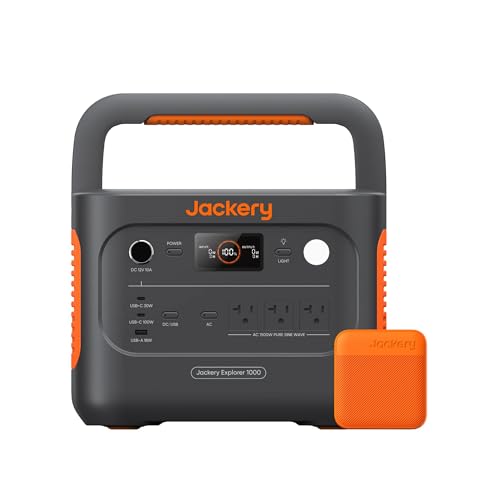
Jackery Solar Generator 1000 v2 with 200W Panel
Best for: balanced output and fast recharging
- Battery Capacity
- 1,070Wh
- Continuous AC Output
- 1,500W
- Surge Wattage
- 3,000W
- Battery Chemistry
- LiFePO4
- AC Recharge Time
- 1 hour (emergency) / 1.7 hours
- Cycle Life
- 4,000 charge cycles to 70%
The Jackery Explorer 1000 V2 offers 1,070Wh of LiFePO4 battery capacity and 1,500W continuous AC output. It weighs 23.8 lbs and measures 13.1 x 9.2 x 11.1 inches. You can recharge it in 1.7 hours normally or 1 hour via emergency mode. The unit includes a 200W solar panel and supports PD 100W USB-C charging. It suits users needing reliable off-grid power with fast replenishment.
- LiFePO4 battery lasts over 10 years with 4,000 cycles
- 1,500W continuous output and 3,000W surge peak
- Charges to 100% in 1.7 hours or 1 hour emergency
- Includes 200W solar panel for off-grid recharging
- PD 100W USB-C port for fast device charging
- 1,070Wh capacity is lower than the 2,042Wh Jackery Explorer 2000 Plus
- 1,500W continuous output is less than the 3,000W+ options available
- 23.8 lb weight is heavier than compact 300Wh models
- You need a balance of high output and portability
- You want a battery with a 10-year lifespan
- You prefer fast AC recharging under two hours
- You require more than 1,500W continuous power
- You need a capacity exceeding 1,070Wh
- You prefer a lighter unit under 20 lbs
Verdict: The Jackery Explorer 1000 V2 Solar Generator fits users who need reliable 1,500W output and fast charging without carrying excessive weight. It is ideal for camping or emergency backup where a 10-year battery life matters.

EcoFlow DELTA 3 Plus with Extra Battery
Best for: Fast charging and expandable home backup
- Battery Capacity
- 1024Wh
- Continuous AC Output
- 1800W
- Battery Chemistry
- LiFePO4
- AC Recharge Time
- 40 minutes to 80%
- Expandable Capacity
- 5kWh
- Cycle Life
- 4000 cycles to 80%
This portable power station offers 1024Wh of LiFePO4 battery capacity and 1800W continuous output. It charges to 80% in 40 minutes via AC input and expands up to 5kWh with extra batteries. The unit includes 10ms UPS protection and powers 13 appliances simultaneously. It suits users needing fast recharge speeds and expandable storage for home backup or camping.
- 1024Wh LiFePO4 battery capacity
- 1800W continuous AC output
- 40-minute AC recharge to 80%
- Expandable up to 5kWh
- 10ms UPS switch-over time
- 27.6 pounds weight is heavier than lighter competitors
- 1024Wh capacity is lower than 2042Wh options on the list
- 1800W output is lower than 2000W+ models available
- You need rapid 40-minute AC charging
- You require expandable capacity up to 5kWh
- You need 10ms UPS protection for sensitive electronics
- You prefer a lighter unit under 20 pounds
- You need more than 1800W continuous output
- You want a larger base capacity without expansion
Verdict: EF EcoFlow DELTA 3 Plus 1024Wh fits users who prioritize fast charging and expandable storage over raw capacity. It is ideal for those needing UPS protection for home backup systems.

Anker SOLIX C200 DC with 60W Solar Panel
Best for: Lightweight backup for small electronics during travel
- Battery Capacity
- 192Wh
- Battery Chemistry
- LiFePO4
- AC Recharge Time
- 50 minutes to 80%
- Features
- LiFePO4 Battery
- Intended Use
- Emergency Use, Outdoor, Travel
- Wattage
- 200W
The Anker SOLIX C200 DC is a compact 192Wh portable power station with a 200W output. It uses LiFePO4 battery chemistry for long-term durability. The unit measures 3.94 x 4.33 x 7.28 inches and weighs 4.19 pounds. It includes a 60W solar panel and charges to 80% in 50 minutes via wall outlet. This small capacity unit suits travelers needing lightweight, reliable backup power for essential devices.
- 192Wh LiFePO4 battery capacity for safe, long-lasting power
- 200W pure sine wave output for sensitive electronics
- Fast recharge to 80% in 50 minutes via AC
- Includes 60W solar panel for off-grid charging
- Compact dimensions at 3.94 x 4.33 x 7.28 inches
- 192Wh capacity is significantly lower than competitors offering over 1000Wh
- 200W max output limits use to small devices, unlike 600W+ options
- 4.19-pound weight is comparable to larger units, reducing portability advantage
- You need a lightweight power source for short trips or camping
- You want to charge small devices like phones and tablets via USB-C
- You prioritize fast AC charging and LiFePO4 longevity over high capacity
- You need to run high-wattage appliances like mini-fridges or power tools
- You require multi-day power without frequent recharging
- You want to power multiple devices simultaneously for extended periods
Verdict: Anker SOLIX C200 DC 192Wh Portable Power Station fits travelers who need a small, durable battery for essential devices. It is not suitable for users requiring high power output or long-duration energy storage.

HOWEASY 300W 222Wh Portable Power Station
Best for: small electronics and light camping
- Battery Capacity
- 222Wh
- Continuous AC Output
- 300W
- Features
- Fast Charging
- Intended Use
- RV, Camping, Emergency Use
- Design
- Foldable
- Output Voltage
- 110V
The HOWEASY 222Wh portable power station delivers 300W of continuous AC output. It weighs 5.5 pounds and measures 8.25 by 4.7 by 5.8 inches. The unit includes a foldable handle that reduces its footprint. You can charge nine devices at once using its various ports. It supports solar, AC, and car charging. This compact unit suits small electronics and light camping needs.
- 222Wh battery capacity for small devices
- 300W continuous AC output
- 9 output ports including 65W USB-C
- 5.5-pound lightweight design
- Built-in 3-level LED flashlight
- 222Wh capacity is lower than most competitors
- 300W output limits high-draw appliances
- 5.5-pound weight adds bulk for ultralight travel
- You need to charge phones and tablets
- You want a compact unit for day trips
- You require a built-in LED light
- You need to power large appliances
- You require more than 222Wh of storage
- You plan to run devices for many hours
Verdict: The HOWEASY 222Wh Portable Power Station fits users who need to charge small electronics on short trips. It offers a compact form factor and multiple ports for basic needs. Buyers requiring higher power or longer runtime should look elsewhere.

BLUETTI 288Wh 600W Power Station
Best for: Lightweight emergency backup and camping
- Battery Capacity
- 288Wh
- Continuous AC Output
- 600W
- Surge Wattage
- 1500W
- Battery Chemistry
- LFP
- AC Recharge Time
- 0-80% in 45 min, 0-100% in 70 min
- Features
- Fast Charging, UPS Function
The BLUETTI Elite 30 V2 is a compact 288Wh portable power station weighing 9.5 pounds. It delivers 600W continuous output with a 1500W surge capability for small appliances. The unit features LFP battery chemistry and a 10ms UPS function for critical devices. You can recharge it fully in 70 minutes via wall power. This model suits users needing lightweight backup for camping or emergency home use.
- 288Wh battery capacity using durable LFP chemistry
- 600W continuous output with 1500W surge power
- 10ms UPS switch protects sensitive electronics
- Fast 380W wall charging reaches 80% in 45 minutes
- 288Wh capacity is lower than the 1024Wh and 2042Wh options on this list
- 600W continuous output is lower than the 1500W and 1024W outputs of other picks
- 9.5 pound weight is heavier than the 9.4 pound Jackery Explorer 300
- You need a lightweight unit under 10 pounds for car camping
- You require a 10ms UPS to keep routers or CPAP machines running
- You want fast 45-minute charging to 80% capacity
- You need to run high-wattage appliances like microwaves or full-size fridges
- You require more than 288Wh of stored energy for multi-day trips
- You prefer a lighter unit under 9 pounds for backpacking
Verdict: The BLUETTI Elite 30 V2 288Wh Power Station fits users who prioritize fast charging and UPS protection in a lightweight package. It is ideal for short trips or emergency backup where 600W is sufficient.

Anker SOLIX C1000 Gen 2 1024Wh Power Station
Best for: Fast recharging and UPS backup needs
- Battery Capacity
- 1,024Wh
- Continuous AC Output
- 2,000W
- Surge Wattage
- 3,000W
- Battery Chemistry
- LiFePO4
- AC Recharge Time
- 49 Min
- Cycle Life
- 4,000 cycles
The Anker SOLIX C1000 Gen 2 offers 1,024Wh of LiFePO4 capacity and 2,000W continuous output. It recharges fully in 49 minutes via AC or 1.8 hours with 600W of solar input. The unit weighs 24.9 pounds and measures 15.1 by 8.2 by 9.6 inches. It provides 10 ms UPS backup and supports 4,000 cycles. This model suits users needing fast refills and reliable emergency power for home or RV use.
- 1,024Wh LiFePO4 battery capacity
- 2,000W continuous and 3,000W peak output
- 49-minute full AC recharge time
- 10 ms UPS switchover for backup
- 4,000 cycle lifespan with 80% retention
- 24.9 pounds weight is heavier than the 192Wh Anker SOLIX C200
- 1,024Wh capacity is lower than the 2,042Wh Jackery Explorer 2000 Plus
- 2,000W output is less than the 3,000W peak of the Jackery 1000 v2
- You need rapid 49-minute AC recharging for quick turnarounds
- You require UPS backup for sensitive electronics like CPAP machines
- You want a LiFePO4 battery with 4,000 cycle longevity
- You need more than 2,000W continuous power for heavy loads
- You prefer a lighter unit under 20 pounds for easy carrying
- You want a larger capacity exceeding 1,024Wh for extended off-grid stays
Verdict: The Anker SOLIX C1000 Gen 2 fits users who prioritize fast recharging and UPS reliability over maximum capacity or lowest weight. It delivers solid power for home backup and RV use without the bulk of larger stations.

Jackery Explorer 2000 Plus 2042Wh Power Station
Best for: heavy loads and high-capacity needs
- Battery Capacity
- 2042.8Wh
- Continuous AC Output
- Up to 3000W
- Battery Chemistry
- LiFePO4
- AC Recharge Time
- 2 hours
- Expandable Capacity
- 12kWh (up to 24kWh)
- Intended Use
- RV, Camping, Emergency Use, Outdoor
The Jackery Explorer 2000 Plus delivers 2042.8Wh of LiFePO4 battery capacity and up to 3000W of continuous AC output. It recharges from zero to full in just 2 hours via wall or solar input. You can expand the system to 12kWh with extra packs or 24kWh by linking two units. This high-capacity station suits heavy loads like air conditioners and RVs.
- 2042.8Wh LiFePO4 battery capacity
- 3000W continuous AC output
- 2-hour full recharge time
- Expandable to 24kWh total capacity
- Larger physical dimensions than the 288Wh models on this list
- Higher price point than the 192Wh and 292Wh options
- You need to power high-wattage appliances like air conditioners
- You require a base capacity over 1000Wh for extended off-grid use
- You want to expand storage up to 24kWh for whole-home backup
- You need a compact unit under 300Wh for easy carrying
- You are looking for a budget-friendly option under 500Wh
- You only need to charge small devices like phones and laptops
Verdict: The Jackery Explorer 2000 Plus 2042Wh is built for users who need substantial power for heavy loads and long durations. It fits those who prioritize high capacity and fast recharging over portability and low cost.
Specifications side by side
| Spec | Jackery Explorer 300 292Wh Power Station | Jackery Solar Generator 1000 v2 with 200W Panel | EcoFlow DELTA 3 Plus with Extra Battery | Anker SOLIX C200 DC with 60W Solar Panel | HOWEASY 300W 222Wh Portable Power Station | BLUETTI 288Wh 600W Power Station | Anker SOLIX C1000 Gen 2 1024Wh Power Station | Jackery Explorer 2000 Plus 2042Wh Power Station |
|---|---|---|---|---|---|---|---|---|
| Battery Capacity | 292Wh | 1,070Wh | 1024Wh | 192Wh | 222Wh | 288Wh | 1,024Wh | 2042.8Wh |
| Continuous AC Output | 300W | 1,500W | 1800W | – | 300W | 600W | 2,000W | Up to 3000W |
| Surge Wattage | 600W | 3,000W | – | – | – | 1500W | 3,000W | – |
| Battery Chemistry | LiFePO4 | LiFePO4 | LiFePO4 | LiFePO4 | – | LFP | LiFePO4 | LiFePO4 |
| AC Recharge Time | – | 1 hour (emergency) / 1.7 hours | 40 minutes to 80% | 50 minutes to 80% | – | 0-80% in 45 min, 0-100% in 70 min | 49 Min | 2 hours |
| Expandable Capacity | – | – | 5kWh | – | – | – | – | 12kWh (up to 24kWh) |
| Cycle Life | over 4,000 cycles to 70% | 4,000 charge cycles to 70% | 4000 cycles to 80% | – | – | – | 4,000 cycles | – |
| Running Wattage | – | – | 1800W | – | 300W | 600W | – | – |
| Features | LiFePO4 Battery | LiFePO4 Battery, Fast Charging | USB Ports, USB-C Output | LiFePO4 Battery | Fast Charging | Fast Charging, UPS Function | LiFePO4 Battery, UPS Function | – |
| Intended Use | Camping, Emergency Use, Travel | RV, Camping, Emergency Use, Off-Grid | Home, Camping, Home Backup, Emergency Use | Emergency Use, Outdoor, Travel | RV, Camping, Emergency Use | Camping, Home Backup, Emergency Use | Emergency Use, Outdoor | RV, Camping, Emergency Use, Outdoor |
| Wattage | – | 200W | – | 200W | – | – | – | – |
| Recommended Use | – | Off-Grid Systems | – | – | – | – | – | – |
| Design | – | – | – | – | Foldable | – | – | – |
| Included Components | Lithium Battery | Lithium Battery | – | Lithium Battery | – | – | Lithium Battery | – |
| Output Voltage | – | – | – | – | 110V | – | – | – |
| Application | – | – | – | – | – | Backup Power | – | – |
| Battery Type | Lithium | Lithium | – | Lithium | – | – | Lithium | – |
| Dimensions | 9.1 × 5.2 × 7.8 inches | 13.1 × 9.2 × 11.1 inches | 16 × 8 × 11 inches | 7.28 × 3.94 × 4.33 inches | 4.7 × 5.8 × 8.25 inches | 12.5 × 13.4 × 9.72 inches | 15.1 × 8.2 × 9.6 inches | 18.7 × 13.9 × 14.6 inches |
| Weight | 7.1 pounds | 23.8 pounds | 27.6 pounds | 4.19 pounds | 5.5 pounds | 9.5 pounds | 24.9 pounds | – |
| Size | 9.1"L x 5.2"W x 7.8"H | 13.1"L x 9.2"W x 11.1"H | – | – | – | – | – | – |
| Color | E300 | Black, Orange | Black | Dark Gray | Grey | – | Gray | Black, Orange |
| Model | JE-300E | JE-1000D | EF-DL-H10-4 | A1727 | K300 | BLUETTI Elite 30 V2 Power Station | A1763 | JE-2000C |
For step-by-step methods on calculating watt-hour needs, refer to the portable power station buying guide.
Frequently asked questions
How do I know if a power station is lightweight enough for camping?
Check the weight specification in the product data. The Anker SOLIX C200 DC weighs 4.19 pounds, making it easy to carry for short trips. The Jackery Explorer 300 is slightly heavier at 7.1 pounds but remains portable. Units over 20 pounds, like the Jackery 1000 V2, are better for car camping or home backup where mobility matters less.
What is the difference between running wattage and surge wattage?
Running wattage is the continuous power the unit supplies. Surge wattage is the temporary peak power for starting motors. The HOWEASY 300W model has a 300W running rating. The BLUETTI 600W unit provides higher continuous output. You must ensure the running wattage exceeds your device’s steady state, while surge handles startup spikes.
Which portable power station has the longest battery lifespan?
Look for LiFePO4 battery chemistry in the attributes. The Jackery Explorer 300, Jackery 1000 V2, and Anker SOLIX C200 DC all use LiFePO4 cells. This chemistry offers greater longevity than standard lithium-ion. The Jackery 1000 V2 is specifically noted for its 10-year battery life, making it durable for long-term emergency use.
Can I expand the capacity of a portable power station?
Some models support external battery expansion. The EcoFlow DELTA 3 Plus is described as having expandable storage. It pairs with an extra battery to increase total capacity. This feature suits users needing more energy for home backup without buying a larger single unit. Check the product description for expansion compatibility.
What size portable power station do I need for emergency home backup?
Select a unit with high capacity and UPS functionality. The Anker SOLIX C1000 Gen 2 offers 1024Wh capacity and UPS protection. The EcoFlow DELTA 3 Plus also provides UPS support and 1800W output. For heavier loads, the Jackery Explorer 2000 Plus delivers 2042Wh capacity. These units handle essential home appliances during outages.
How fast can these power stations recharge from empty?
Fast charging is a key feature for several models. The Jackery 1000 V2 and HOWEASY 300W both highlight fast charging capabilities. The EcoFlow DELTA 3 Plus is noted for rapid recharging speeds. This allows you to restore power quickly after use. Check the specific charging time in the full specs if available.
Are these power stations suitable for RV use?
Yes, many are designed for RV and off-grid applications. The Jackery 1000 V2 and HOWEASY 300W list RV as an intended use. The Jackery 2000 Plus is also suitable for RV environments. These units provide reliable power for onboard electronics and appliances. Ensure the running wattage meets your RV’s electrical demands.
What is the physical size of the Anker SOLIX C200 DC?
The Anker SOLIX C200 DC is compact and portable. It measures 7.28 inches in length, 3.94 inches in width, and 4.33 inches in height. This small footprint fits easily in travel bags. It weighs only 4.19 pounds, making it ideal for backpacking or small car trips where space is limited.