
As Amazon Associates, we earn from qualifying purchases. This means we may receive a small commission at no extra cost to you if you click through and make a purchase.
As an Amazon Associate we earn from qualifying purchases. Links on this page are affiliate links.
This jackery vs EBL portable power station comparison focuses on specs rather than marketing claims. Both units offer AC outlets and solar charging for camping or emergencies. The main difference lies in their power levels and battery chemistry. The Jackery Explorer 300 uses durable LiFePO4 cells and weighs less. The EBL unit provides higher capacity and output but relies on standard lithium chemistry. You should choose based on your wattage needs and weight preferences.
Battery Capacity
292Wh
519.48Wh
Continuous AC Output
300W
500W
Surge Wattage
600W
1000W
Battery Chemistry
LiFePO4
lithium
Weight
7.1 pounds
18 pounds
Cycle Life
over 4,000 cycles to 70%
not listed
Choose the first if
- You need a lighter unit for hiking or backpacking trips.
- You want a battery with a significantly longer lifespan of over 4,000 cycles.
- You only need to power small devices like phones and cameras.
Choose the second if
- You need to run higher-wattage appliances like mini-fridges or power tools.
- You require a larger battery capacity to keep devices running longer.
- You want more output ports, including wireless charging and quick-charge USB options.
Verdict
Choose the Jackery Explorer 300 if portability and long-term battery durability are your top priorities. Select the EBL 500W model if you need more power to run larger devices and do not mind the extra weight. Both units serve well for camping, but their specs target different use cases.
Jackery vs EBL Portable Power Stations Compared
Battery capacity and output
Edge: EBL 500W 519Wh Portable Power Station
The EBL 500W offers a significantly larger energy reserve with 519.48Wh of capacity, compared to the Jackery Explorer 300’s 292Wh. This difference allows the EBL unit to run devices for longer periods before needing a recharge. In terms of raw power delivery, the EBL provides 500W of continuous AC output and a 1000W surge rating. The Jackery Explorer 300 delivers 300W continuous output with a 600W surge. If you need to power higher-wattage appliances or keep electronics running for extended off-grid trips, the EBL’s larger capacity and higher wattage give it a clear advantage in performance potential.
Battery chemistry and lifespan
Edge: Jackery Explorer 300 292Wh Power Station
The Jackery Explorer 300 uses LiFePO4 battery chemistry, which is known for stability and longevity. It is rated for over 4,000 charge cycles to 70% capacity, ensuring more than 11 years of service life. The EBL unit uses standard lithium chemistry, but its specific cycle life and warranty duration are not listed in the provided specifications. LiFePO4 batteries generally withstand more deep discharges and temperature variations than standard lithium-ion cells. For users prioritizing long-term durability and a longer replacement cycle, the Jackery’s chemistries and stated cycle count offer a distinct benefit over the unspecified lifespan of the EBL model.
Weight and portability
Edge: Jackery Explorer 300 292Wh Power Station
Portability is a key factor for outdoor use, and the Jackery Explorer 300 is significantly lighter at 7.1 pounds. The EBL 500W weighs 18 pounds, making it more than twice as heavy. The Jackery also features an integrated handle, described as making it effortless to carry on hikes or pack with camping gear. The EBL unit is bulkier and heavier, which may be less convenient for carrying during long treks or frequent relocations. If you plan to carry the power station regularly, the Jackery’s compact and lightweight design is the superior choice for ease of transport.
Charging options and speed
Edge: Jackery Explorer 300 292Wh Power Station
Both units support solar charging, but the Jackery reaches 80% capacity in approximately 2.8 hours with a 100W panel, while the EBL takes 6-9 hours for a full charge with a 100W+ panel. For wall charging, the EBL restores power in 6-7 hours. The Jackery’s charging time via wall outlet is not explicitly listed in the data. The Jackery also includes a car port for vehicle charging. The EBL offers a wireless charging pad and multiple USB ports, including QC 3.0 and PD 60W. While the EBL has more diverse output ports, the Jackery offers faster solar replenishment for its smaller capacity.
Output ports and versatility
Edge: Tie
The EBL 500W provides more output variety with 2 AC outlets, 3 USB-A QC 3.0 ports, 1 USB-C PD 60W port, 2 DC ports, a 12V car port, and a wireless charging pad. The Jackery Explorer 300 offers 2 AC outlets, 1 USB-C PD 100W port, 2 USB-A ports, and a 120W car port. The Jackery’s USB-C port supports higher wattage at 100W, which is better for fast-charging laptops. The EBL includes a wireless charging surface, which the Jackery lacks. Both units can power multiple devices simultaneously, but the Jackery’s higher USB-C wattage and the EBL’s wireless pad cater to different user preferences.
Which portable power station fits your needs
Hikers seeking lightweight durable gear
Our pick: Jackery Explorer 300 292Wh Power Station
The Jackery Explorer 300 weighs just 7.1 pounds, making it significantly lighter than the 18-pound EBL unit. Its LiFePO4 battery chemistry offers over 4,000 charge cycles, ensuring more than 11 years of service life. This durability and low weight make it ideal for long hikes where every ounce matters.
Campers needing higher power output
Our pick: EBL 500W 519Wh Portable Power Station
The EBL 500W provides 519.48Wh of capacity and 500W continuous output, nearly double the Jackery’s 292Wh and 300W. This extra power allows you to run larger appliances like mini-fridges or CPAP machines for longer periods. The higher surge wattage of 1000W also handles startup spikes from motorized devices more effectively.
Users wanting versatile charging ports
Our pick: EBL 500W 519Wh Portable Power Station
The EBL unit includes three USB-A Quick Charge 3.0 ports and a wireless charging pad, offering more connectivity options than the Jackery. It also features two DC ports alongside its AC outlets. This variety lets you charge multiple devices simultaneously, including those requiring fast USB-C PD or standard USB-A connections.
Emergency preppers valuing longevity
Our pick: Jackery Explorer 300 292Wh Power Station
The Jackery’s LiFePO4 battery lasts over 4,000 cycles to 70% capacity, far exceeding typical lithium-ion alternatives. This longevity ensures reliable performance for emergency backups over many years. While the EBL has more capacity, the Jackery’s chemical stability and cycle life make it a more sustainable long-term investment for critical power needs.

Jackery Explorer 300 292Wh Power Station
Best for: Lightweight camping and CPAP backup
- Battery Capacity
- 292Wh
- Continuous AC Output
- 300W
- Surge Wattage
- 600W
- Battery Chemistry
- LiFePO4
- Cycle Life
- over 4,000 cycles to 70%
- Features
- LiFePO4 Battery
The Jackery Explorer 300 is a compact power station with 292Wh capacity and 300W continuous output. It weighs 7.1 pounds and uses LiFePO4 chemistry for over 4,000 cycles. You get two AC outlets, USB-C PD, and a 12V port. This unit suits hikers and campers needing lightweight, durable backup power for small electronics and CPAP devices.
- LiFePO4 battery chemistry offers over 4,000 charge cycles to 70% capacity
- Lightweight design at 7.1 pounds for easy portability
- Includes 2 AC outlets, 100W USB-C PD port, and 120W car port
- Fast solar charging reaches 80% capacity in 2.8 hours with a 100W panel
- Lower 292Wh capacity compared to the 519.48Wh EBL option
- Lower 300W continuous output compared to the 500W EBL option
- Heavier build at 7.1 pounds compared to the 7.5 lbs industry average claim context
- You need a lightweight power source for hiking or backpacking
- You want long-term durability with LiFePO4 battery chemistry
- You require reliable backup for small electronics and CPAP machines
- You need to power high-wattage appliances like microwaves
- You require a battery capacity larger than 292Wh
- You prefer a lighter unit under 7 pounds
Verdict: Jackery Explorer 300 Portable Power Station fits hikers and campers who prioritize long battery life and portability over raw power output. It is ideal for keeping small devices running for days without adding significant weight to your gear.
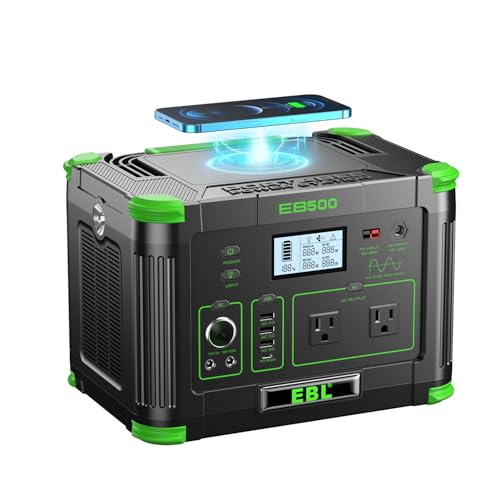
EBL 500W 519Wh Portable Power Station
Best for: campers needing solar and car charging options
- Battery Capacity
- 519.48Wh
- Continuous AC Output
- 500W
- Surge Wattage
- 1000W
- Battery Chemistry
- lithium
- AC Recharge Time
- 6-7 hours
- Intended Use
- Camping, Emergency Use, Outdoor
The EBL E500 offers 519.48Wh of lithium battery capacity and 500W continuous AC output. It weighs 18 pounds and measures 11.5 by 7.9 by 7.9 inches. You can recharge it via wall outlet in 6-7 hours, solar panels in 6-9 hours, or a car port in 7-8 hours. This unit supports devices up to 500W with a 1000W surge capacity. It includes multiple USB ports and a wireless charging pad for versatile device support.
- 519.48Wh battery capacity provides substantial energy storage
- 500W continuous output with 1000W surge capability
- Recharges via wall, solar, or car outlet
- Includes wireless charging pad and multiple USB ports
- Heavier at 18 pounds compared to the 14.1-pound competitor
- Smaller 519.48Wh capacity versus the competitor's 292Wh LiFePO4 model
- Longer 6-7 hour wall recharge time
- You need versatile charging options including solar and car ports
- You require a wireless charging pad for compatible devices
- You want a high surge capacity for starting small appliances
- You prioritize long-term battery cycle life over initial capacity
- You need a lighter unit for frequent carrying
- You require faster wall outlet recharge speeds
Verdict: The EBL 500W Portable Power Station suits users who need flexible charging methods and a wireless charging pad. It fits those who value higher surge power and do not mind the extra weight for a larger lithium battery capacity.
Specifications side by side
| Spec | Jackery Explorer 300 292Wh Power Station | EBL 500W 519Wh Portable Power Station |
|---|---|---|
| Battery Capacity | 292Wh | 519.48Wh |
| Continuous AC Output | 300W | 500W |
| Surge Wattage | 600W | 1000W |
| Battery Chemistry | LiFePO4 | lithium |
| AC Recharge Time | – | 6-7 hours |
| Cycle Life | over 4,000 cycles to 70% | – |
| Features | LiFePO4 Battery | – |
| Intended Use | Camping, Emergency Use, Travel | Camping, Emergency Use, Outdoor |
| Included Components | Lithium Battery | – |
| Battery Type | Lithium | – |
| Dimensions | 9.1 × 5.2 × 7.8 inches | 11.5 × 7.9 × 7.9 inches |
| Weight | 7.1 pounds | 18 pounds |
| Size | 9.1"L x 5.2"W x 7.8"H | 500W |
| Color | E300 | Dark Green |
| Model | JE-300E | EB500 |
Frequently asked questions
Is the Jackery Explorer 300 better for hiking than the EBL 500W?
Yes, if you prioritize portability. The Jackery Explorer 300 weighs only 7.1 pounds, making it much easier to carry on trails. The EBL 500W is heavier at 18 pounds. This weight difference makes the Jackery a superior choice for backpackers who need lightweight gear for long hikes.
Which power station has more battery capacity?
The EBL 500W has more capacity. It holds 519Wh of energy, which is significantly higher than the Jackery Explorer 300’s 292Wh. This allows the EBL unit to power devices for longer durations. You should choose the EBL if you need to run electronics for extended periods away from outlets.
Does the Jackery Explorer 300 use a safe battery type?
Yes, it uses LiFePO4 battery chemistry. This type of lithium battery is known for stability and a longer lifespan compared to standard lithium-ion cells. It supports over 4,000 charge cycles, ensuring the unit remains reliable for more than 11 years of regular use in camping or emergency scenarios.
What are the dimensions of the EBL 500W?
The EBL 500W measures 11.5 inches in length, 7.9 inches in width, and 7.9 inches in height. These dimensions make it bulkier than the Jackery Explorer 300. You should ensure you have enough space in your vehicle or campsite to accommodate this larger footprint during your trips.
Can I charge these units with solar panels?
Yes, both units support solar charging. This feature allows you to replenish the battery using sunlight while camping or during power outages. Solar compatibility makes both the Jackery and EBL options versatile for outdoor adventures where grid electricity is unavailable. You can keep your devices powered indefinitely with sufficient solar exposure.
Which unit is more compact for travel?
The Jackery Explorer 300 is more compact. It measures 9.1 inches by 5.2 inches by 7.8 inches, fitting easily into smaller bags. The EBL 500W is larger and heavier. If you are traveling by car or plane and need to save space, the Jackery’s smaller form factor is the better option.
Does the EBL 500W offer wireless charging?
Yes, the EBL 500W includes a wireless charging pad. This feature allows you to charge compatible devices without cables, adding convenience to your setup. The Jackery Explorer 300 does not mention this specific feature in its specifications. You should choose the EBL if you prefer cable-free charging for your phone.


