
As Amazon Associates, we earn from qualifying purchases. This means we may receive a small commission at no extra cost to you if you click through and make a purchase.
As an Amazon Associate we earn from qualifying purchases. Links on this page are affiliate links.
This epever 100a mppt solar charge review looks at the Tracer AN series controller. It is a DC automatic voltage identification unit rated for 100A output. The device supports 12V, 24V, 36V, and 48V battery systems. It accepts a maximum PV input voltage of 150V. The unit uses MPPT technology with a tracking efficiency of at least 99.5%. It weighs 18.3 pounds and measures 15.5 inches in length. This specification-focused analysis explains how these numbers affect your solar setup.
- MPPT tracking efficiency no less than 99.5%
- Rated output current of 100A
- Supports 12V, 24V, 36V, and 48V systems
- Max PV input voltage of 150V
- Adaptive three-stage charging mode
Good fit for
You should consider this controller if you need a high-capacity solution for larger solar arrays. The 100A rating handles substantial current loads. The automatic voltage identification simplifies installation across different battery voltages. The isolated RS485 interface allows for MODBUS communication, which is useful for remote monitoring. If you plan to expand your system with parallel charging, this unit supports up to eight units in parallel. It is also suitable for solar RVs and household systems requiring reliable hybrid power integration.
Who can skip it
You should look at another option if you require a compact, lightweight controller for small mobile applications. This unit weighs 18.3 pounds and measures 15.5 inches in length. The physical size may not fit in tight spaces. If you only need a 60A or 80A capacity, the smaller variations in this series are more appropriate. Additionally, if you do not need advanced communication features like RS485, you might find the extra complexity unnecessary for a basic off-grid setup.
Verdict
The EPEVER Tracer 100A is a robust controller defined by its high current rating and versatile voltage support. It suits users who need scalable power management with monitoring capabilities.
Key specs explained for this controller
Rated Output Current: 100A
This value tells you the maximum continuous current the unit can handle. You can connect solar panels that produce up to 100 amps of charging current. This suits larger solar arrays or high-drain battery banks. When comparing portable power stations, look for similar high-current input limits to ensure your solar gear matches the station’s capacity without bottlenecking the charge rate.
Max PV Input Voltage: 150V
This is the highest voltage your solar panels can send to the controller. You can use panels with a high open-circuit voltage. This allows you to wire panels in series to reach higher voltages efficiently. When shopping for portable power stations, check if the station accepts high-voltage solar input. A higher limit gives you more flexibility in panel configuration.
Battery System Voltage: 12V/24V/36V/48V DC
The controller automatically identifies and adapts to these four system voltages. You do not need to manually set the voltage for your battery bank. This works with 12V, 24V, 36V, or 48V batteries. When comparing portable power stations, ensure the station supports your battery voltage. Automatic identification simplifies setup for hybrid systems or larger off-grid setups.
Tracking Technology: MPPT
MPPT stands for Maximum Power Point Tracking. It adjusts the electrical operating point of the panels to extract the most power possible. This technology typically yields higher efficiency than older PWM controllers. When evaluating portable power stations, look for MPPT solar input. This ensures your solar panels charge your station faster and more effectively in varying light conditions.
Design and build details
According to the listing, the EPEVER Tracer 10415AN measures 15.5 inches in length, 9.52 inches in width, and 5.62 inches in height. The unit weighs 18.3 pounds. This mass suggests a robust internal construction capable of handling the rated 100A output current. The physical footprint allows for mounting in standard electrical enclosures or on walls within solar installations. The device is described as the 100A 150V model.
The controller features an isolated RS485 interface using the standard MODBUS communication protocol. This port includes a 5V power supply, which simplifies system expansion. You can connect up to eight units in parallel to increase capacity. This design supports hybrid power setups where monitoring and load control are critical. The presence of auto-control relays for load, utility, or generator input further enables complex system configurations.
The front panel includes a digital display for real-time energy recording and statistical functions. You can monitor battery temperature compensation and automatic over-temperature power reduction directly from the interface. The adaptive three-stage charging mode is managed via a digital control circuit. This electronic management helps prolong battery life by adjusting charge cycles based on the selected battery type, such as sealed, gel, or flooded. The layout prioritizes functional access to data and settings rather than aesthetic features.
Setup and everyday use
Setup begins with connecting the battery first. The Tracer AN series automatically identifies system voltage. It supports 12V, 24V, 36V, and 48V DC configurations. You do not need to manually set the voltage. This adaptive feature simplifies initial installation for various battery banks.
Next, connect the solar array to the PV input. The unit handles a maximum PV input voltage of 150V. Ensure your panels stay within this limit. The controller uses advanced MPPT technology with a tracking efficiency of at least 99.5%. This high efficiency means you get more usable power from your panels.
Daily operation relies on the adaptive three-stage charging mode. This digital control circuit manages the charge cycles to prolong battery life. You can choose from four battery types: Sealed, Gel, Flooded, or User-defined. This flexibility allows you to optimize charging for your specific battery chemistry.
The controller includes comprehensive electronic protections. It guards against overcharging, over-discharging, and PV reverse polarity. These features ensure safer and more reliable operation. The unit also features automatic over-temperature power reduction. This function protects the device during high ambient temperatures.
For monitoring, the device offers an isolated RS485 interface with standard MODBUS protocol. You can connect up to eight units in parallel for larger systems. This setup supports real-time energy recording and statistical functions. The controller also includes load, utility, or generator auto-control relays. These relays make it easy to compose a hybrid power system for RVs, households, or field monitoring applications.
Before You Buy This Controller
This unit is a solar charge controller, not a portable power station or generator. You cannot plug appliances directly into it. You need a battery bank to store energy and an inverter to convert DC power to AC for your devices. The Tracer AN series works with sealed, gel, flooded, or user-defined batteries. Check your battery voltage matches the controller’s 12V, 24V, 36V, or 48V support. It automatically identifies the system voltage, which simplifies setup. Ensure your solar array’s open-circuit voltage stays below the 150V max input. You may need RS485 cables for monitoring if you want to track energy stats. The controller includes protections against overcharging and reverse polarity. Regularly check connections for corrosion. This device fits into larger off-grid systems rather than serving as a standalone power source like the portable stations on this page.
Check before you buy
- Confirm your battery bank voltage matches the controller’s auto-identification range.
- Ensure solar panel voltage stays under the 150V maximum input.
- Verify you have a compatible inverter for AC power needs.
- Check if you need RS485 cables for system monitoring.
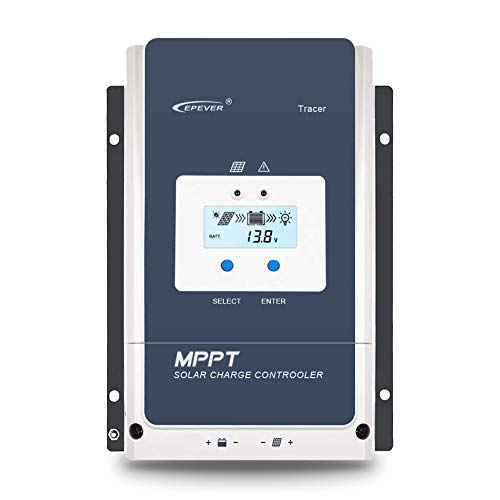
EPEVER Tracer 100A MPPT Controller
Best for: large solar arrays needing 100A capacity
- Rated Output Current
- 100A
- Max PV Input Voltage
- 150V
- Battery System Voltage
- 12V/24V/36V/48V DC
- Tracking Technology
- MPPT
- Compatible Battery Types
- Sealed, Gel, Flooded, User
- Dimensions
- 15.5 × 9.52 × 5.62 inches
This EPEVER Tracer 100A MPPT controller manages solar energy for 12V, 24V, 36V, or 48V battery systems. It features a 100A rated output current and handles up to 150V PV input. The unit uses MPPT technology with 99.5% tracking efficiency. It supports sealed, gel, flooded, and user-defined battery types. You get a robust device for hybrid power setups with RS485 communication options.
- 100A rated output current for high-capacity systems
- 150V maximum PV input voltage
- MPPT tracking efficiency of 99.5%
- Supports 12V, 24V, 36V, and 48V battery voltages
- Adaptive three-stage charging mode
- Heavy build at 18.3 pounds
- Large dimensions of 15.5 inches by 9.52 inches by 5.62 inches
- You need a 100A controller for large solar arrays
- You operate a 48V battery system
- You require RS485 monitoring capabilities
- You have limited mounting space
- You prefer a lightweight portable unit
- You only need a 12V system with low current
Verdict: EPEVER Tracer 100A MPPT Controller suits users with large solar installations requiring high current handling and multi-voltage support. Its substantial size and weight demand dedicated mounting space.
Specifications side by side
| Spec | EPEVER Tracer 100A MPPT Controller |
|---|---|
| Rated Output Current | 100A |
| Max PV Input Voltage | 150V |
| Battery System Voltage | 12V/24V/36V/48V DC |
| Tracking Technology | MPPT |
| Compatible Battery Types | Sealed, Gel, Flooded, User |
| Voltage | 12V |
| Current Rating | 100A |
| Technology | MPPT |
| Dimensions | 15.5 × 9.52 × 5.62 inches |
| Weight | 18.3 pounds |
| Size | 100A |
| Color | 100A 150V |
| Model | Tracer10415AN |
Frequently asked questions
Can the EPEVER Tracer 100A work with 48V batteries?
Yes, this controller supports multiple battery voltages. It automatically identifies and works with 12V, 24V, 36V, and 48V DC systems. You do not need to manually configure the voltage setting. This adaptability allows you to use it with various battery bank configurations without additional setup steps.
What is the maximum solar panel voltage for this unit?
The maximum PV input voltage is 150V. This limit determines the highest open-circuit voltage your solar array can produce. You must ensure your panel string does not exceed this threshold, even in cold weather. Exceeding this limit can damage the controller permanently.
How large is the EPEVER Tracer 100A controller?
The unit measures 15.5 inches in length, 9.52 inches in width, and 5.62 inches in height. It weighs 18.3 pounds. You need a dedicated mounting space that accommodates these dimensions. The substantial size reflects its high current handling capability and robust internal components.
Does this controller handle 100 amps continuously?
Yes, the rated output current is 100A. This is the maximum continuous current the unit can manage. You can connect solar panels that generate up to 100 amps of charging current. This capacity suits large solar arrays or high-drain battery banks requiring significant power input.
Is this device a portable power station?
No, this is a solar charge controller, not a power station. You cannot plug appliances directly into it. It manages energy flow between solar panels and a battery bank. You need a separate inverter to convert stored DC power to AC for your devices.
What model number is the EPEVER 100A MPPT?
The specific model is the Tracer10415AN. This identifier helps you find compatible accessories and documentation. It confirms the unit is part of the Tracer AN series with 100A capacity and 150V input. Use this model number when searching for replacement parts or technical manuals.


