As Amazon Associates, we earn from qualifying purchases. This means we may receive a small commission at no extra cost to you if you click through and make a purchase.
As an Amazon Associate we earn from qualifying purchases. Links on this page are affiliate links.
You are comparing the callsun 400w bifacial solar panel vs 420w models from Callsun. Both use N-type monocrystalline cells with 16BB technology and offer bifacial energy gain. They share dual-module anti-shading designs and IP68 junction boxes. The main difference lies in their electrical output and physical dimensions. The 400W set delivers higher voltage for specific portable stations, while the 420W set supports a wider range of system voltages up to 48V. You must check your input limits carefully.
Rated Wattage
400 W (2x 200 W)
420 W (2 x 210 W)
Operating Voltage (Vmp)
47.48 V (series)
34.2 V each
System Voltage Support
12V/24V
12V-48V
Dimensions (L x W)
51.3 x 30.3 inches
54.2 x 30.2 inches
Weight
23.8 lbs
24.9 lbs
Choose the first if
- You need a higher series voltage (47.48V) to match the 60V-class input limits of certain portable power stations.
- You have limited roof space and prefer a slightly more compact footprint.
- You are running a 12V or 24V system and want a lighter panel set.
Choose the second if
- You require flexibility for 36V or 48V battery systems in your off-grid setup.
- You want to support a broader list of compatible portable power stations, including EcoFlow Delta 3 series and Anker SOLIX models.
- You prefer a higher total wattage output for faster charging potential.
Verdict
Choose the 400W model if your portable power station requires a higher voltage input around 47V. Select the 420W model if you need compatibility with 48V systems or a wider array of specific power station brands. Both offer reliable bifacial performance and anti-shading features.
Callsun 400W vs 420W Panel Comparison
Output voltage and current
Edge: Callsun 420W Bifacial N-Type Solar Panel
The Callsun 400W Bifacial Solar Panel 2-Pack operates at 47.48V Vmp and 54.62V Voc with an 8.43A current when paired in series. This configuration targets portable power stations with 60V-class solar input limits. In contrast, the Callsun 420W Bifacial N-Type Solar Panel delivers 34.2V Vmp and 40.3V Voc per panel. The 420W model supports a broader range of system voltages, from 12V to 48V, offering greater flexibility for different battery setups. If you need higher voltage for specific station inputs, the 400W series connection is better. For versatile 12V-48V compatibility, the 420W model is superior.
Portability and dimensions
Edge: Callsun 400W Bifacial Solar Panel 2-Pack
Size and weight matter when you are installing panels on RVs, vans, or boats. Each panel in the Callsun 400W Bifacial Solar Panel 2-Pack measures 51.3 by 30.3 by 1.4 inches and weighs 23.8 lbs. The Callsun 420W Bifacial N-Type Solar Panel is slightly larger, measuring 54.2 by 30.2 by 1.4 inches, and weighs 24.9 lbs per panel. The 400W model is shorter and lighter, making it easier to fit into tighter spaces or handle during installation. The 420W model requires more surface area and adds slightly more weight to your roof. If compactness is your priority, the 400W model wins.
Compatibility with power stations
Edge: Callsun 420W Bifacial N-Type Solar Panel
The Callsun 420W Bifacial N-Type Solar Panel explicitly lists compatibility with a wide array of portable power stations, including BLUETTI Elite and AC series, EcoFlow DELTA and RIVER series, Anker SOLIX models, and Pecron units. It also notes support for 12V-48V systems via MPPT controllers. The Callsun 400W Bifacial Solar Panel 2-Pack mentions suitability for portable power stations with 60V-class solar input limits but does not list specific brands. The 420W model provides clearer guidance on which devices it works with, reducing guesswork for buyers with existing equipment.
Shading and bifacial gain
Edge: Callsun 420W Bifacial N-Type Solar Panel
Both panels share a dual-module parallel design that divides each unit into two independently operating sections. This TwinCell or dual-module anti-shading feature ensures that if one side is blocked by trees or vents, the other continues generating power. Both also use N-type monocrystalline cells with 16BB technology to reduce hot spots. The Callsun 420W Bifacial N-Type Solar Panel highlights a potential bifacial energy gain of up to 30% from reflected light. The Callsun 400W Bifacial Solar Panel 2-Pack notes additional energy from the rear but does not specify a percentage. The 420W model offers a clearer quantification of its bifacial benefits.
Temperature performance
Edge: Callsun 400W Bifacial Solar Panel 2-Pack
Heat reduces solar panel efficiency over time. The Callsun 400W Bifacial Solar Panel 2-Pack specifies a low temperature coefficient of just -0.30%/K. This helps maintain stable energy generation during hot summer conditions, which is critical for RVs and off-grid homes in warm climates. The data for the Callsun 420W Bifacial N-Type Solar Panel does not list a temperature coefficient. While both use similar N-type cells, the 400W model provides concrete data on how it handles heat. If you live in a hot region, this specific spec helps you predict real-world performance more accurately.
Which Callsun Solar Panel Fits Your Setup
RV owners with 60V portable power stations
Our pick: Callsun 400W Bifacial Solar Panel 2-Pack
This 400W 2-pack pairs in series to reach 47.48V Vmp and 54.62V Voc. This voltage range aligns well with portable power stations that have 60V-class solar input limits. You get 8.43A of operating current, maximizing charging speed for your specific equipment without exceeding input thresholds.
Users needing flexible 12V to 48V systems
Our pick: Callsun 420W Bifacial N-Type Solar Panel
These panels operate at 34.2V Vmp each, supporting 12V to 48V battery systems via an MPPT controller. You can wire them in series for 36V or 48V setups, or parallel for lower voltages. This flexibility simplifies matching different battery banks and future off-grid upgrades without complex panel matching.
Buyers wanting maximum total wattage output
Our pick: Callsun 420W Bifacial N-Type Solar Panel
The 420W kit delivers 210W per panel, totaling 420W compared to the 400W alternative. This higher rated wattage provides more baseline power generation. Both use N-type monocrystalline cells with 25.6% efficiency, but the 420W model offers a greater total energy yield for your off-grid or marine applications.
Those prioritizing compact footprint and weight
Our pick: Callsun 400W Bifacial Solar Panel 2-Pack
Each 200W panel measures 51.3 by 30.3 inches and weighs 23.8 lbs. The 420W alternative is longer at 54.2 inches and heavier at 24.9 lbs per panel. If space on an RV roof or boat deck is tight, the smaller dimensions and lighter weight of the 400W pair offer a better fit.

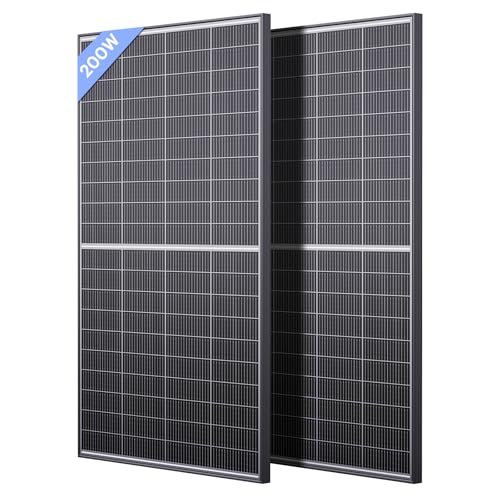
Callsun 400W Bifacial Solar Panel 2-Pack
Best for: RVs and off-grid systems needing bifacial gain
- Rated Wattage
- 400 W (2x 200 W)
- Cell Efficiency
- Up to 25.6%
- Cell Type
- N-Type 16BB Monocrystalline
- System Voltage
- 12V/24V
- IP Rating
- IP68
- Weight
- 23.8 lbs
This Callsun 400W setup pairs two 200W bifacial panels for portable power stations. It uses N-type 16BB monocrystalline cells with 25.6% efficiency. The series connection yields 47.48V Vmp and 54.62V Voc. Each panel weighs 23.8 lbs and measures 51.3 by 30.3 inches. The design includes TwinCell anti-shading features and an IP68 junction box. It suits RVs and off-grid use in hot climates.
- 25.6% cell efficiency with N-type 16BB technology
- Bifacial design captures rear-side sunlight
- TwinCell anti-shading design maintains output
- Low -0.30%/K temperature coefficient for hot weather
- IP68-rated junction box for weather resistance
- Lower rated wattage of 400W compared to the 420W alternative
- Heavier total weight of 23.8 lbs per panel
- Thicker profile at 1.38 inches height
- You need bifacial energy gain in reflective environments
- You want a 400W input for 60V-class portable stations
- You operate in hot climates with high temperatures
- You require maximum wattage per panel
- You prioritize the lightest possible weight
- You need a thinner profile for low-clearance roofs
Verdict: Callsun 400W Bifacial Solar Panel offers strong efficiency and shading resilience for users who value bifacial gain and hot-climate performance over raw wattage or minimal weight.

Callsun 420W Bifacial N-Type Solar Panel
Best for: RV and marine off-grid power
- Rated Wattage
- 420W (2x210W)
- Cell Efficiency
- 25.6%
- Cell Type
- N-Type Monocrystalline, 16BB
- System Voltage
- 12V-48V
- Weight
- 24.9 lbs
- Intended Use
- RV, Off-Grid
This kit includes two 210W N-Type bifacial panels, totaling 420W. Each panel weighs 24.9 lbs and measures 54.2 by 30.2 inches. The design captures reflected light for up to 30% extra energy. You can wire them in series or parallel for 12V to 48V systems. This setup suits RVs and boats where space is tight but power needs are steady.
- N-Type monocrystalline cells with 25.6% efficiency
- Bifacial design gains up to 30% energy from reflected light
- Dual-module parallel design keeps power flowing if one side is shaded
- Supports 12V to 48V systems via series or parallel wiring
- 16BB current network helps limit microcrack impact
- Heavier build at 24.9 lbs per panel
- Larger footprint at 54.2 by 30.2 inches
- Lower rated wattage than the 420W single-panel option
- You need flexible wiring for 12V to 48V battery systems
- You want bifacial technology to boost yield on reflective surfaces
- You need shade tolerance for partial roof obstructions
- You prefer a single, lighter panel for easier handling
- You have limited roof space for a 54.2-inch panel
- You want the maximum possible wattage per square inch
Verdict: Callsun 420W Bifacial Solar Panel offers reliable power for mobile setups. It fits users who value bifacial gain and shade tolerance over a single heavy panel.
Specifications side by side
| Spec | Callsun 400W Bifacial Solar Panel 2-Pack | Callsun 420W Bifacial N-Type Solar Panel |
|---|---|---|
| Rated Wattage | 400 W (2x 200 W) | 420W (2x210W) |
| Cell Efficiency | Up to 25.6% | 25.6% |
| Cell Type | N-Type 16BB Monocrystalline | N-Type Monocrystalline, 16BB |
| System Voltage | 12V/24V | 12V-48V |
| IP Rating | IP68 | – |
| Weight | 23.8 lbs | 24.9 lbs |
| Intended Use | Home, RV, Off-Grid | RV, Off-Grid |
| Voltage | 12V | 48V |
| Wattage | 200W | – |
| Recommended Use | Off-Grid Systems, Boats & Marine, Rooftops | Off-Grid Systems, Boats & Marine |
| Design | Bifacial | Bifacial |
| Dimensions | 51.3 × 30.3 × 1.38 inches | 54.2 × 30.2 × 1.4 inches |
| Size | 200W 2-Pack Black | 2PCS 210W |
| Color | Black | Black |
| Model | CN200W | CN210W |
Frequently asked questions
Which Callsun panel is better for RVs with 60V input limits?
The Callsun 400W Bifacial Solar Panel 2-Pack is the better choice. It reaches 47.48V Vmp when paired in series. This voltage aligns with 60V-class portable power stations. The 420W model operates at 48V Vmp but targets 48V systems. You get two panels in the 400W pack for easier installation.
How do the dimensions of these solar panels compare?
The 420W model is slightly longer and heavier. It measures 54.2 inches in length and weighs 24.9 pounds. The 400W 2-pack panels are 51.3 inches long and weigh 23.8 pounds each. Both share a similar width of about 30.3 inches. The height is nearly identical at 1.38 inches versus 1.4 inches.
Do both models use N-type cells?
Yes, both panels use N-type cell technology. This design offers better shading resilience and efficiency. You benefit from improved performance in hot climates. The bifacial design on both models allows them to capture light from both sides. This feature boosts overall energy yield compared to standard panels.
What is the weight difference between the two options?
The Callsun 420W panel weighs 24.9 pounds. The 400W 2-pack panels weigh 23.8 pounds each. The difference is small, but the 400W option is lighter per unit. This matters if you are mounting panels on an RV roof. Lighter panels reduce the stress on your roof structure.
Can I use these panels for marine applications?
Yes, both models are recommended for marine use. The 400W pack is suitable for boats needing bifacial gain. The 420W model is also listed for boats and marine off-grid systems. Both feature IP68 junction boxes for weather resistance. You can trust them in wet environments.
Which panel has a higher voltage output?
The 420W model has a higher Vmp of 48V. The 400W 2-pack reaches 47.48V Vmp in series. Both are designed for specific system voltages. The 420W targets 48V systems. The 400W pack targets 60V-class inputs. Choose based on your power station's input limit.
Are these panels suitable for off-grid homes?
Yes, both models are intended for off-grid systems. The 400W pack is ideal for homes needing bifacial gain. The 420W model fits users who value shade tolerance. Both use N-type cells for reliability. You can install them on rooftops for residential power generation.
What color are these Callsun solar panels?
Both models are black. The 400W 2-pack is described as black. The 420W model is also black. This color helps them blend with most roof surfaces. The bifacial design allows light to pass through or reflect from the back. You get a sleek, uniform look.