As Amazon Associates, we earn from qualifying purchases. This means we may receive a small commission at no extra cost to you if you click through and make a purchase.
As an Amazon Associate we earn from qualifying purchases. Links on this page are affiliate links.
You need the best renogy solar panels under $2000 to power your off-grid home or marine system. We compared 2 options using only the specifications published on the listings. The Renogy 2400W Bifacial Solar Panel Set leads because its 2400W running wattage delivers maximum energy harvest for fixed installations. This high output makes it ideal for residential setups where weight and mounting strength are sufficient. Our guide helps you decide which panel matches your specific power density and shading requirements.
Match wattage to your power needs
Check the running wattage before you buy. The top pick offers 2400W for high-output residential use. A single panel option provides 400W for smaller setups. Choose the set if you need maximum energy harvest for fixed installations. Select the single unit if you prioritize power density for off-grid or marine applications. Your choice depends entirely on your daily energy consumption.
| # | Product | Best for | Price |
|---|---|---|---|
| 1 | Renogy 2400W Bifacial Solar Panel Set Best overall | High-output off-grid residential and marine systems | |
| 2 | Renogy 400W Bifacial Solar Panel Best monocrystalline | high-efficiency off-grid and marine installations |
The best fit for you
- You need high output for fixed residential off-grid systems – Renogy 2400W Bifacial Solar Panel Set – The 2400W total wattage and bifacial design maximize energy harvest for your home.
- You want high efficiency with shade tolerance for marine use – Renogy 400W Bifacial Solar Panel – N-Type monocrystalline cells and bifacial design deliver power density and shade tolerance.
- You require durable panels for farms and sheds – Renogy 2400W Bifacial Solar Panel Set – The 400W per panel rating supports robust off-grid applications in agricultural settings.

Renogy 2400W Bifacial Solar Panel Set
Best for: High-output off-grid residential and marine systems
- Rated Wattage
- 2400W
- Cell Efficiency
- 25%
- Cell Type
- 16BB N-Type
- Weight
- 45.4 pounds
- Intended Use
- Home, Off-Grid
- Recommended Use
- Off-Grid Systems, Boats & Marine, Rooftops, Farms, Sheds
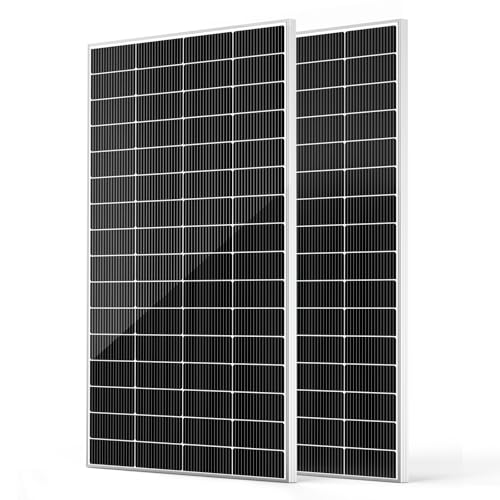
This Renogy solar array combines six 400W bifacial panels for a total rated wattage of 2400W. The 25% efficient N-Type cells capture light from both sides, boosting output in reflective environments. At 45.4 pounds each, the units offer high density per square foot. The dual-module design mitigates partial shading. This setup suits off-grid homes, boats, or farms where maximizing energy harvest from limited roof space is a priority.
- 2400W total rated wattage from six 400W panels
- 25% cell efficiency with N-Type technology
- Bifacial design captures reflected light for up to 30% more energy
- Dual-module structure reduces partial shading impact
- Fewer connections required compared to lower-wattage alternatives
- Each panel weighs 45.4 pounds, requiring sturdy mounting
- Total width of 44.7 inches limits placement on smaller roofs
- Height of 67.8 inches may exceed standard RV awning clearances
- You need high power density from a limited rooftop footprint
- You have a reflective surface like white gravel or light-colored roofing
- You want to simplify wiring by using fewer, higher-wattage panels
- You are installing on a lightweight RV roof with low weight limits
- You require a single-panel solution for a small shed
- You need a compact kit that fits under standard awning heights
Verdict: Renogy 2400W Bifacial N-Type Panel delivers maximum energy harvest for fixed installations where weight and mounting strength are sufficient. It is the right pick for homeowners and off-grid setups prioritizing output over portability.
Renogy 400W Bifacial Solar Panel
Best for: high-efficiency off-grid and marine installations
- Rated Wattage
- 400 W
- Cell Efficiency
- 25%
- Cell Type
- N-Type 16BB Monocrystalline
- Weight
- 45.4 lbs
- Running Wattage
- 2400W
- Intended Use
- Home, Off-Grid
This Renogy panel uses N-Type monocrystalline cells with 25% efficiency to deliver 400 watts per unit. The bifacial design captures reflected light from surfaces like snow or concrete, potentially increasing output by up to 30%. Each unit weighs 45.4 pounds and measures 67.8 inches by 44.7 inches. The dual-module layout allows independent operation of power zones, maintaining generation under partial shade. It suits off-grid homes and marine applications needing high density.
- 25% cell efficiency with N-Type 16BB technology
- Bifacial design captures up to 30% more energy
- Dual-module zones prevent total loss from shade
- 400W rated wattage reduces wiring complexity
- 45.4-pound weight requires sturdy mounting
- 67.8-inch height limits placement on smaller roofs
- 400W output is lower than the 2400W array option
- You need high power density per square foot
- You install on reflective surfaces like white gravel
- You want to minimize branch connectors and wiring
- You have limited roof space for large panels
- You require a single continuous string without shading zones
- You prefer lighter panels for easy manual handling
Verdict: Renogy 400W Bifacial N-Type Solar Panel delivers high efficiency and shade tolerance for users prioritizing power density. It fits off-grid systems where reflective ground or rooftop surfaces can boost bifacial gain.
Specifications side by side
| Spec | Renogy 2400W Bifacial Solar Panel Set | Renogy 400W Bifacial Solar Panel |
|---|---|---|
| Rated Wattage | 2400W | 400 W |
| Cell Efficiency | 25% | 25% |
| Cell Type | 16BB N-Type | N-Type 16BB Monocrystalline |
| Weight | 45.4 pounds | 45.4 lbs |
| Running Wattage | 2400W | 2400W |
| Intended Use | Home, Off-Grid | Home, Off-Grid |
| Wattage | 400W | 400W |
| Recommended Use | Off-Grid Systems, Boats & Marine, Rooftops, Farms, Sheds | Off-Grid Systems, Boats & Marine, Farms, Sheds |
| Design | Bifacial | Bifacial |
| Dimensions | 44.7 × 1.4 × 67.8 inches | 44.7 × 1.4 × 67.8 inches |
| Color | Black | Black |
| Model | RSP400DCT-108×6-US | RSP400DCT-108×6-US |
How to choose the right solar panel
Match total wattage to load
Check the running wattage first. It determines how much energy the system generates in real time. The top pick offers 2400W total, which suits high-output residential needs. A single panel provides 400W for smaller setups. Ensure your inverter can handle the total output. Higher wattage means more power for appliances. Choose a set if you need maximum energy harvest. Select a single unit if space or budget limits your capacity. Compare the total running wattage against your daily consumption needs.
Check cell type for efficiency
Look at the cell type listed in the specs. N-Type cells offer better performance in low light. The top picks use N-Type technology. This means higher efficiency and less degradation over time. Monocrystalline cells are also present in the second option. They provide high power density in a small area. This is useful for marine or rooftop installations. Choose N-Type if you want long-term reliability. Check the cell type to ensure you get the best conversion rate from sunlight to electricity.
Use bifacial design for gain
Consider the panel design if you have reflective surfaces. Bifacial panels capture light from both sides. The listed options use this design. They can generate extra power from ground or rooftop reflection. This is ideal for fixed installations with clear space below. It boosts total energy harvest without adding more panels. If you mount panels close to a dark surface, the gain is lower. Choose bifacial for maximum output in open areas. Check the design spec to see if this feature is available.
Verify weight for mounting
Check the weight of each panel before mounting. The listed panels weigh 45.4 pounds each. This is heavy for rooftop or boat use. Ensure your mounting structure can support this load. Heavier panels are often more durable but harder to handle. For off-grid sheds or farms, weight is less critical. For marine or portable setups, lighter options may be better. Verify the weight spec against your mounting capacity. Do not exceed the structural limits of your roof or boat deck.
Confirm intended use compatibility
Match the intended use to your setup. The top pick is for home and off-grid systems. It is not designed for portable camping. The second option also targets home and off-grid use. It fits marine installations due to its design. Check the recommended use list on the spec sheet. Ensure the panel is suitable for your specific environment. Rooftops, farms, and sheds are common applications. Avoid using residential panels for frequent transport. Verify compatibility to prevent damage or voided warranties.
Frequently asked questions
Are Renogy bifacial panels worth the investment?
Yes, if you have reflective surfaces. The top picks use a bifacial design to capture sunlight from both sides. This setup maximizes energy harvest for fixed installations. It is ideal for homeowners and off-grid systems where mounting strength is sufficient. The extra gain boosts total output compared to standard panels.
What cell type do these Renogy panels use?
They use N-Type cells. The 2400W set and the 400W panel both feature N-Type technology. This cell type offers high efficiency and better shade tolerance. It delivers power density for marine and off-grid use. N-Type cells generally maintain performance better over time than older technologies.
How heavy are the Renogy solar panels?
Each panel weighs 45.4 pounds. The dimensions are 67.8 inches in height and 44.7 inches in length. The width is just 1.4 inches. This weight requires strong mounting hardware. You need to ensure your roof or marine structure can support this load safely.
Can I use Renogy panels on a boat?
Yes, they are suitable for marine use. The recommended uses include boats and marine applications. The bifacial design helps when reflective water surfaces are present. N-Type cells provide reliability in varying light conditions. Just ensure your mounting system is secure for marine environments.
Do these panels work for shed power?
They work well for sheds. The 400W single panel is good for smaller setups. The 2400W set suits larger off-grid needs. Both are recommended for sheds and farms. Check your total wattage requirements first. Match the running wattage to your specific power load in the shed.
What is the difference between the two picks?
The main difference is the bundle size. The top pick is a 2400W set for high-output needs. The second pick is a single 400W panel. Both use the same N-Type monocrystalline cells and bifacial design. Choose the set for maximum energy. Choose the single panel for smaller, simpler installations.
Are these panels suitable for home off-grid systems?
Yes, they are designed for home off-grid use. The 2400W running wattage delivers maximum energy for residential needs. The bifacial design increases efficiency. N-Type cells offer shade tolerance. These specs make them right for homeowners prioritizing output over portability. They fit fixed installations perfectly.